
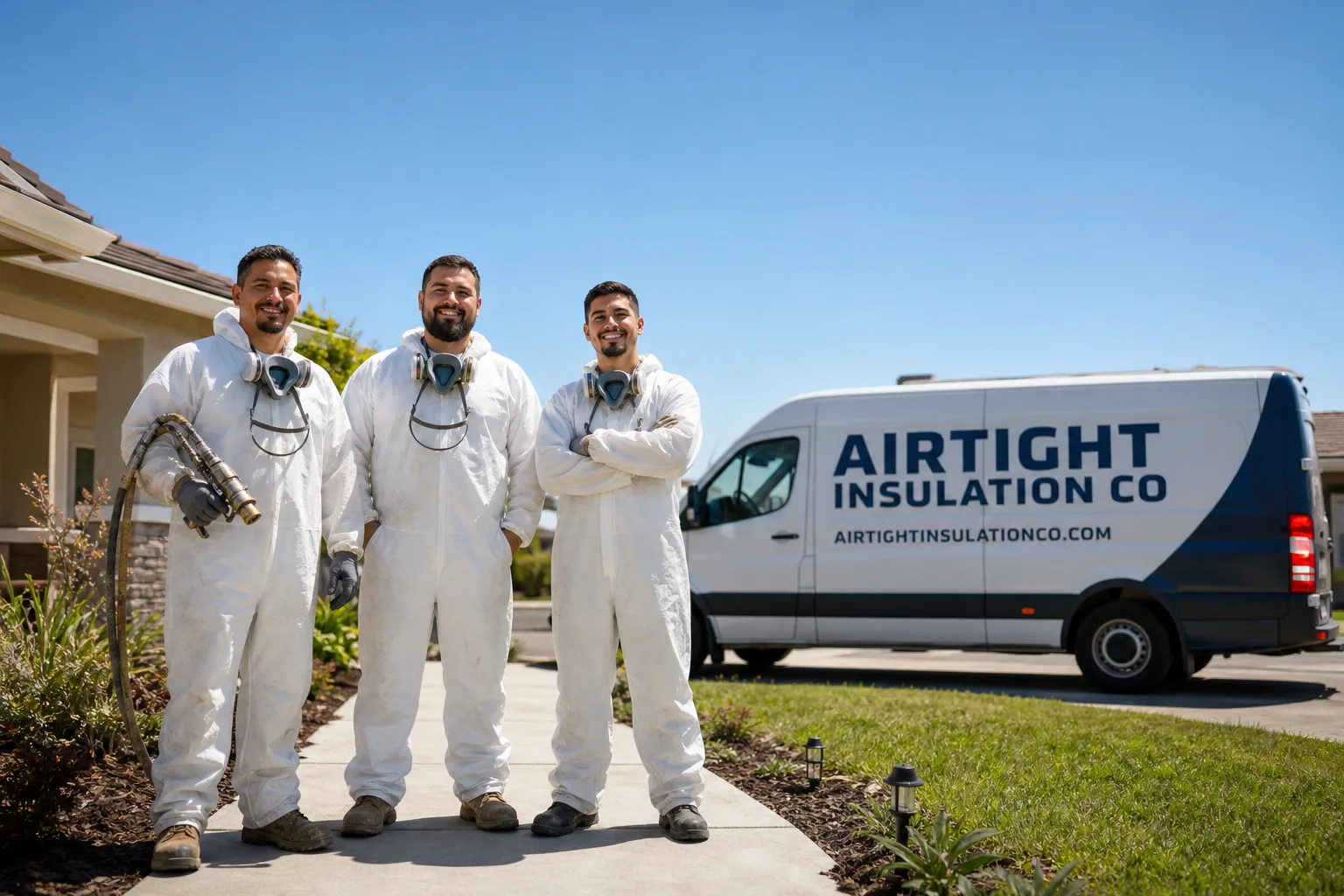
Fast, Reliable Spray Foam Insulation Across Studio City
Spray foam insulation in Studio City costs between $2,800 and $7,400 for a typical attic, and $5,500 to $12,000 for closed-cell applications in hillside wall cavities or roof decks. Most jobs in Studio City are completed within two to four days, and we schedule service calls across 91604 and 91614 five days a week. If your energy bills climb every summer while your air conditioner runs without stopping, the problem is usually air movement through your attic or walls, not your HVAC equipment. We know the older housing stock here intimately, from the flat-lot ranches off Moorpark Street to the canyon homes stacked above Laurel Canyon Boulevard. Call (833) 390-7079 for a free estimate, and our team will diagnose what’s actually happening in your attic before recommending anything.
Why Airtight Insulation Co Is Studio City’s Preferred Spray Foam Insulation Company
Studio City homeowners call us when a previous insulation job didn’t fix the problem. That’s not a dig at anyone. It’s just what happens when someone quotes R-value without looking at how air actually moves through a 1950s ranch or a hillside build on a steep grade. The canyon side of Studio City and the flatland below Ventura Blvd are completely different buildings, and they need different foam specifications. We carry eight manufacturer brands and install open-cell and closed-cell foam through our dedicated Icynene and Demilec lines, so we match material to the cavity, not to whatever is left in the truck. We’re the multi-solution insulation specialist serving Studio City, and our lead is Ruben Acosta, who has spent years working on exactly the kind of irregular, expanded, re-roofed homes that dominate this area’s 91604 ZIP code.
Being local to the San Fernando Valley means we know what happens to an unsealed attic in August. Summer highs routinely push past 100°F here, and a poorly insulated roof deck turns an upstairs bedroom into an oven by 3 p.m. That’s not a generic California problem. It’s a Studio City and Valley problem, and it’s the main reason we’re called. Homeowners in Studio City also tell us the same thing after we finish: the house feels quieter, the rooms hold temperature, and the AC finally cycles off. Performance you can feel. That’s the standard, and it applies whether we’re foaming a 1,100-square-foot ranch off Tujunga Avenue or a three-level canyon home above Fryman Canyon.
Spray Foam Insulation Contractors in Studio City
Our Spray Foam Insulation Contractors in Studio City handle open-cell, closed-cell, rim joist, garage ceiling, and roof deck applications for homes and light-commercial buildings across both 91604 and 91614. This is the role where hands-on experience with irregular architecture matters most. Studio City is not a grid of identical floor plans. It’s a mix of 1940s tracts, 1960s split-levels, and architect-designed hillside homes with cavities that never see a straight line. A contractor who only knows rectangular attics will struggle here. We don’t.
Closed-Cell for Canyon Walls and Rim Joists
On hillside homes above Laurel Canyon, we often recommend closed-cell foam for rim joists and sloped wall cavities. It adds structural rigidity and blocks moisture migration, which matters when one wall is buried into a hillside. Closed-cell also delivers around R-7 per inch, so a tight cavity gets real thermal performance without forcing the homeowner to rebuild the framing.
Open-Cell for Sound and Air Sealing
For interior walls and vented attic floors in flatland ranches, open-cell foam is more practical. It costs less per board foot and still seals air. In a 1,500-square-foot ranch off Colfax Avenue, air sealing is usually the bigger win than adding R-value, because the leaks around can lights, duct chases, and top plates are what drive the cooling bill.
Spray Foam Attic Insulation in Studio City
Spray Foam Attic Insulation in Studio City usually means one of two things: a vented attic where we foam the floor, or an unvented attic where we foam the roof deck. The split depends on whether the attic has ridge and soffit vents that actually work. In Studio City’s mid-century ranches, we frequently find soffit vents blocked by decades of repainting, which means the attic was never breathing properly to begin with. Foaming the roofline in that case converts the attic to conditioned space and stops the heat before it ever reaches the insulation.
Legacy Insulation Removal and Replacement
A 1958 ranch off Ventura Blvd had original fiberglass that had settled to about R-7. That’s effectively nothing. We don’t foam over dead insulation. We remove it, air-seal the penetrations, and then apply the right foam for the assembly. In unvented attics, roof deck foam stops radiant heat at the source, which is the single most impactful change you can make in a Valley summer.
Air Sealing First, R-Value Second
The name Airtight isn’t a slogan. It’s the install standard. Seal it, not just fill it. An attic with R-30 batts and a dozen air leaks still loses conditioned air every time the HVAC cycles. We seal the top plates, around recessed lights, around flues, and at the knee walls before we quote the foam depth. That’s the difference between an insulation job that looks right and one that actually changes the temperature in the hallway.
Trusted Brands We Service in Studio City
We don’t push one foam brand. We stock and install Icynene and Demilec for spray foam, plus Owens Corning, Johns Manville, Knauf, and GreenFiber for fiberglass and cellulose where those materials make more sense. Eight brands, one contractor. That flexibility means a Studio City homeowner with a steep cathedral ceiling gets a Demilec closed-cell spec, while a flat-lot rancher looking for attic air sealing might get open-cell Icynene at a lower cost per square foot. We let the job pick the product. Our vans carry local stock for common Studio City project sizes, which keeps turnaround tight even during peak summer months when attic temperatures are at their worst.
Common Spray Foam Insulation Problems We See in Studio City Homes
- Settled insulation on sloped ceilings: Canyon homes above Laurel Canyon often have sloped ceiling cavities where blown-in fiberglass or cellulose has drifted downhill over the years, leaving the upper portion of the ceiling insulated and the lower portion bare. We check the slope-facing side first, because that’s where hot spots show up first.
- Foam applied over junk insulation: We regularly see homes where someone shot foam over settled, rodent-damaged, or water-stained existing insulation in a 1950s attic. The foam creates a cap, but the thermal boundary underneath is still compromised. It looks sealed. It isn’t.
- Unsealed penetrations in mid-century ranches: Recessed lights, bathroom fans, and plumbing chases in 1940s and 1950s houses off Moorpark and Colfax leak conditioned air directly into the attic. If those aren’t sealed before the foam goes in, you’re paying for foam around holes.
- Moisture trapping in low-slope roofs: Hillside homes with low-slope assemblies and the wrong foam thickness can trap moisture against roof decking. That leads to rot. Closed-cell foam with the proper depth and an understanding of the assembly prevents this, which is why hillside specs in Studio City should never be copied from a flatland quote. Each lot has its own conditions, and the same ZIP code does not mean the same install.
Pricing for Spray Foam Insulation in Studio City, CA
A typical open-cell attic application in a Studio City ranch runs $2,800 to $5,200. Closed-cell roof deck work on the same home runs $4,800 to $7,400. Hillside wall cavities and rim joist work in canyon homes range from $5,500 to $12,000 depending on access, slope, and cavity depth. Garage ceiling foam jobs usually land between $900 and $2,100. What drives the number is not square footage alone. It’s whether we’re removing old insulation, how many penetrations need sealing, and whether the attic is vented or unvented. Every estimate includes the exact foam type, depth, and coverage area, written down before we start. Call (833) 390-7079 for a free, no-pressure estimate.
We Also Serve Cities Near Studio City
Our crews work throughout the San Fernando Valley and nearby hills. We serve North Hollywood, Universal City, Sherman Oaks, and West Hollywood, with the same lot-by-lot approach we use across Studio City. If you’re in the 91604 or 91614 ZIP or just outside it, call us and we’ll confirm scheduling. We also run Spray Foam Insulation jobs daily across the entire greater Los Angeles area.
Serving Studio City, CA — Our Local Coverage Area
We’re based in the Studio City area and know this community well. Use the map below to see our service coverage — if you’re nearby, we can almost certainly help.
FAQs About Spray Foam Insulation in Studio City
Spray foam outperforms fiberglass in Studio City’s summer heat because it seals air, not just slows it down. Traditional batts work by trapping air, but they don’t stop air from moving through gaps around wires, pipes, and framing. On a 105°F Valley day, that moving air turns your attic into a heater. Closed-cell foam on a roof deck can reduce heat gain by half or more versus settled fiberglass, and that’s before you factor in the air sealing. Homeowners who switched to foam in Studio City routinely report bedrooms staying 10 to 15 degrees cooler without changing their AC settings.
Yes. Hillside homes in Studio City require closed-cell foam in wall cavities and sloped ceilings because it doesn’t settle, adds structural strength, and blocks moisture from the hillside side of the wall. Flat-lot ranches can often use open-cell foam in the attic, which costs less and still seals the building envelope. The deciding factor is the wall and roof assembly, not just the budget. A canyon home on a steep grade above Laurel Canyon has different physics than a ranch off Moorpark, and the foam spec has to match those physics. If someone quotes you the same spec for both, they haven’t looked at your house.
No, not properly. Spray foam needs a clean, dry substrate to bond and form an air seal. Applying it over settled fiberglass, blown-in cellulose, or insulation with rodent damage creates a foam cap with a gap underneath, which means air still moves. In older Studio City homes, we remove the existing insulation, inspect the framing and wiring, seal the penetrations, and then apply foam. It costs a bit more upfront, but the alternative is paying for foam that doesn’t do its job. Call (833) 390-7079 and we’ll tell you honestly whether your old insulation needs to come out.
For most 1950s ranches in Studio City with working vented attics, open-cell foam on the attic floor is the right call. It air-seals the ceiling plane, costs less than closed-cell, and still makes a dramatic difference in a Valley summer. If the attic is unvented or the soffit vents are blocked, we’ll recommend closed-cell foam on the roof deck instead. The answer depends on what we find when we get into the attic. Many of these older homes on the flats off Colfax and Tujunga have vents that were painted shut decades ago, and no one noticed until the upstairs became unbearable.
Spray foam cures in place and does not settle, so it eliminates the drift problem that plagues blown-in insulation in sloped Studio City ceiling cavities. In canyon homes above Laurel Canyon, we use closed-cell foam in those sloped assemblies. It bonds to the roof deck and framing, keeping the thermal boundary consistent from the ridge to the eave. That means no more hot spots on the downhill side of the ceiling, and no more mystery rooms that never hold temperature. The fix is permanent, not something you’ll crawl up to re-fluff in five years.
Ready to fix the comfort problem in your Studio City home? Call Airtight Insulation Co at (833) 390-7079 for a free estimate. We’ll inspect your attic or walls, tell you what’s actually going on, and give you a written quote with the exact material and depth specified. No pressure, no vague numbers. Just an honest answer about what your house needs.
Written by Ruben Acosta, Owner at Airtight Insulation Co, serving Studio City and the San Fernando Valley.