
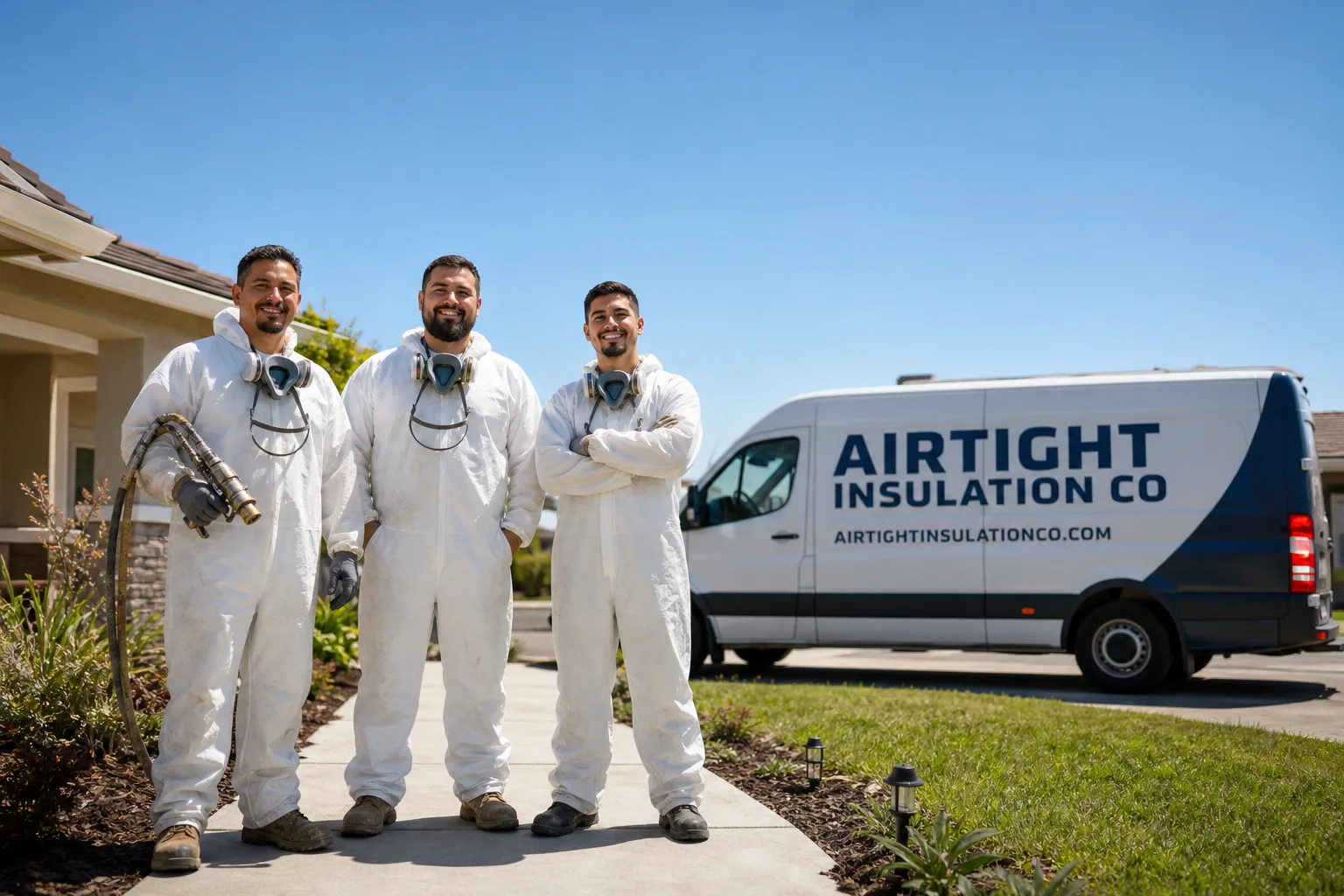
Fast, Reliable Spray Foam Insulation Across San Gabriel
Spray foam insulation in San Gabriel typically costs $2.50 – $6.50 per board foot installed, with most attic retrofit jobs landing between $3,800 and $9,200 depending on square footage and whether we’re insulating the attic floor or the roof deck. We run crews through San Gabriel multiple times per week, and most open-cell attic jobs on pre-1960 bungalows take one day. If your energy bills climb every summer and your upstairs rooms never cool down, the uninsulated attic over your head is likely the culprit.
Airtight Insulation Co works throughout San Gabriel’s older neighborhoods, from the Mission District east to the 91776 side of town. Ruben Acosta, who leads our team, grew up in the San Gabriel Valley and understands what these 1920s and 1940s homes need. Call (833) 390-7079 and we’ll schedule a walk-through, take attic measurements, and tell you exactly what we found and what it costs to fix.
Why Airtight Insulation Co Is San Gabriel’s Preferred Spray Foam Insulation Company
San Gabriel homeowners call us because we treat their houses as what they are: older, plaster-and-lath construction with attics that were never designed for modern insulation. Many contractors approach a 1930s bungalow the same way they’d approach a 2020 tract home, and the result is foam slapped over old rock-wool with no air sealing. We do the opposite.
Our crews know the numbered streets around the Mission District, the ranch homes west of San Gabriel Boulevard, and the detached-garage-heavy lots in 91775. We stock Demilec and Icynene spray foam products specifically because they perform consistently in the inland San Gabriel Valley climate, where attic temperatures push well past 140°F on August afternoons. When a San Gabriel customer calls at 7 a.m., we can typically have a tech out within 24 hours. Ruben Acosta reviews every San Gabriel job estimate personally before it goes out.
Open Cell Spray Foam in San Gabriel
Open Cell Spray Foam is our most-requested attic application in San Gabriel’s older housing stock, because it delivers air sealing and R-value in one pass. In a 1920s or 1940s attic with no vapor barrier, open-cell applied to the underside of the roof deck creates a conditioned attic that stops heat from entering the living space below. Most San Gabriel attic roof deck jobs run $4,200 – $8,500, while open-cell on an attic floor (less common, usually done with blown-in cellulose in these homes) runs $2,800 – $5,400.
What a San Gabriel Retrofit Job Actually Involves
Before any foam goes down in a pre-1960 home, we air-seal. That means removing or consolidating old rock-wool, sealing every penetration (wiring holes, plumbing chases, top plates), and installing baffles at the eaves so the soffit vents can still breathe. Skipping this step in a Mission District bungalow is how you get foam that looks fine but traps moisture against the roof sheathing.
Where Open-Cell Shines in San Gabriel’s Climate
San Gabriel’s inland heat means cooling loads dominate for seven months of the year. Open-cell foam at the roofline drops attic temperatures dramatically and stops the heat from radiating down through the ceiling. It also cuts dust and the familiar “hot upstairs, cold downstairs” complaint that’s common in the two-story additions along the 91776 side of town.
Spray Foam Insulation Contractors in San Gabriel
Spray Foam Insulation Contractors in San Gabriel should be able to explain why your 1940s attic needs air sealing before insulation, not just quote you a square-footage price. Our installers are trained on both Icynene and Demilec spray foam systems, and we carry both open-cell and closed-cell formulations. For a typical San Gabriel bungalow attic retrofit, labor and material together run $3,800 – $9,200. Rim joist spray foam in a pier-and-beam foundation, which many pre-1960 homes on the 91775 side have, runs $1,400 – $2,600.
Old Housing, Specialized Approach
We see a lot of original rock-wool and early fiberglass batts in San Gabriel attics. Some of it has been there since the Truman administration. The right sequence is remove or reposition that material, seal the attic floor, baffle the eaves, then apply foam. A contractor who skips straight to spraying is creating a future moisture problem.
Honest Conversations Before We Quote
Sometimes the right answer in a San Gabriel home is not spray foam at all. If your attic has deep, dry existing insulation and you’re mainly fighting radiant heat, a radiant barrier plus air sealing may serve you better and cost less. We carry eight brands and three installation methods through our Spray Foam Insulation division and our blown-in and batt offerings, so we can tell you when foam is the best tool and when it isn’t.
Trusted Brands We Service in San Gabriel
We install Icynene and Demilec spray foam, and we keep both open-cell and closed-cell in stock for San Gabriel jobs. The reason we carry two foam brands rather than one is simple: different attics need different densities, expansion rates, and vapor permeability. Our San Gabriel customers also have access to Owens Corning and GreenFiber products when a mixed-material retrofit makes more sense than foam everywhere. Parts and materials are stocked locally in the San Gabriel Valley, so we’re not waiting on a distributor in Riverside when your job is scheduled.
Common Spray Foam Insulation Problems We See in San Gabriel Homes
- Foam over original rock-wool without air sealing. We regularly open up attics in San Gabriel’s 1920s and 1930s homes and find loose 1940s-era rock-wool sitting under newer fiberglass. When spray foam is applied directly over disturbed rock-wool without sealing the attic floor first, moisture from the living space rises and gets trapped, causing adhesion failure and, eventually, musty odors in the bedrooms below.
- Open-cell foam in unvented attics without vapor management. Pre-1950 bungalows around the Mission District often have no vapor barrier at all. Incorrectly installed open-cell foam can allow warm, moist indoor air to reach the roof sheathing, condense, and rot the wood over several years. Our protocol includes checking the roof assembly and, where needed, using the right formulation.
- Blocked eaves on low-pitch roofs. San Gabriel bungalows frequently have low-slope roof lines. Without baffles at the soffit vents, spray foam can block the only airflow path and cause the foam to overheat and degrade prematurely. The baffle step adds a few hundred dollars but prevents a five-figure roof repair later.
- Duct condensation in unconditioned attics. In older San Gabriel homes where HVAC ducts run through the attic, hot attic air meets the cold duct surface and produces condensation that drips onto ceilings. Customers describe it as a “water stain that keeps coming back.” Insulating and sealing the attic stops the temperature differential, which stops the condensation.
Pricing for Spray Foam Insulation in San Gabriel, CA
Expect open-cell spray foam in San Gabriel to run $2.50 – $4.50 per board foot for attic roof deck applications, and closed-cell to run $4.00 – $6.50 per board foot. A complete attic retrofit on a 1,200-square-foot Mission District bungalow typically lands between $4,200 and $7,800. Rim joist jobs run $1,400 – $2,600. Garage ceiling spray foam runs $1,800 – $3,200 for a detached two-car garage. The big variable on older homes is prep work: removing rock-wool, sealing the attic floor, and baffling eaves adds $800 – $1,500 depending on attic size and accessibility. We provide a written, line-item estimate before starting, and estimates are free. Call (833) 390-7079 to schedule a walk-through.
We Also Serve Cities Near San Gabriel
Our crews cover San Gabriel and the surrounding San Gabriel Valley communities. We regularly work in East San Gabriel, San Marino, Alhambra, and Rosemead. If you’re in one of those cities and your attic hasn’t been touched since the Eisenhower years, we’ll give you the same straight answer we give in San Gabriel. Call (833) 390-7079.
Serving San Gabriel, CA — Our Local Coverage Area
We’re based in the San Gabriel area and know this community well. Use the map below to see our service coverage — if you’re nearby, we can almost certainly help.
FAQs About Spray Foam Insulation in San Gabriel
No, and we’ll tell you that before you spend a dollar. Spray foam applied over loose original rock-wool without air-sealing the attic floor first will hold moisture against the structural members and fail to adhere properly. In San Gabriel’s pre-1960 homes, the correct sequence is to remove or consolidate the old rock-wool, seal every attic floor penetration, baffle the eaves, and only then apply foam. If a contractor tells you they can spray right over the old stuff, they’re saving themselves labor at your home’s expense. Call (833) 390-7079 and we’ll walk you through what your specific attic needs.
San Gabriel sits in the San Gabriel Valley heat belt, where summer attic temperatures routinely hit 140°F or more, well above what coastal LA homes experience. That heat radiates through uninsulated ceilings and forces your AC to run constantly. Open-cell spray foam at the roof deck holds attic temperatures within a few degrees of the living space, which means your cooling system doesn’t fight a 140°F air mass above the ceiling. The effect is especially noticeable in the older bungalows and Spanish-revival homes around the Mission District.
It depends on where you’re applying the foam and which formulation you use. Closed-cell spray foam is a vapor barrier itself, at the right thickness. Open-cell is vapor permeable and needs careful attention in unvented attic assemblies. In San Gabriel’s older homes, which were built without vapor barriers, the key is getting the assembly right, not just adding plastic sheeting. We evaluate the roof pitch, ventilation, and existing conditions before recommending one formulation over the other. Call (833) 390-7079 for an attic assessment and a direct answer.
Open-cell is lighter, expands more, costs less per board foot, and provides R-3.5 to R-4 per inch plus excellent air sealing. It’s the right choice for most San Gabriel attic roof deck retrofits. Closed-cell is denser, provides R-6 to R-7 per inch, and acts as a vapor barrier. It costs more and is useful for rim joists, crawl spaces in pier-and-beam homes, and situations where moisture control matters as much as R-value. Most of the pre-1960 San Gabriel homes we work on get open-cell in the attic and closed-cell at the rim joists.
Yes, this is one of the most common problems we solve in San Gabriel’s older housing stock. When HVAC ducts run through an unconditioned attic, the cold duct surface meets 140°F attic air and produces condensation, which drips onto the ceiling and shows up as recurring water stains. Sealing and insulating the attic keeps the ductwork close to indoor temperature and stops the condensation at the source. We recently handled a 1920s Spanish-revival bungalow near the Mission District with exactly this issue. The attic had no vapor barrier and only scattered 1940s rock-wool. Our techs air-sealed the attic floor, installed baffles at the eaves, and applied open-cell spray foam from Icynene to the underside of the roof deck. Attic temperatures dropped by 20°F immediately, and the duct condensation stopped. Call (833) 390-7079 if this sounds like your home.
If your San Gabriel home has a hot, uninsulated attic or rooms that never get comfortable, call Airtight Insulation Co at (833) 390-7079. We’ll inspect your attic, tell you what we find, and give you a written estimate. No pressure, just straight answers about what your house actually needs.
Written by Ruben Acosta, Owner at Airtight Insulation Co, serving San Gabriel and the San Gabriel Valley.