
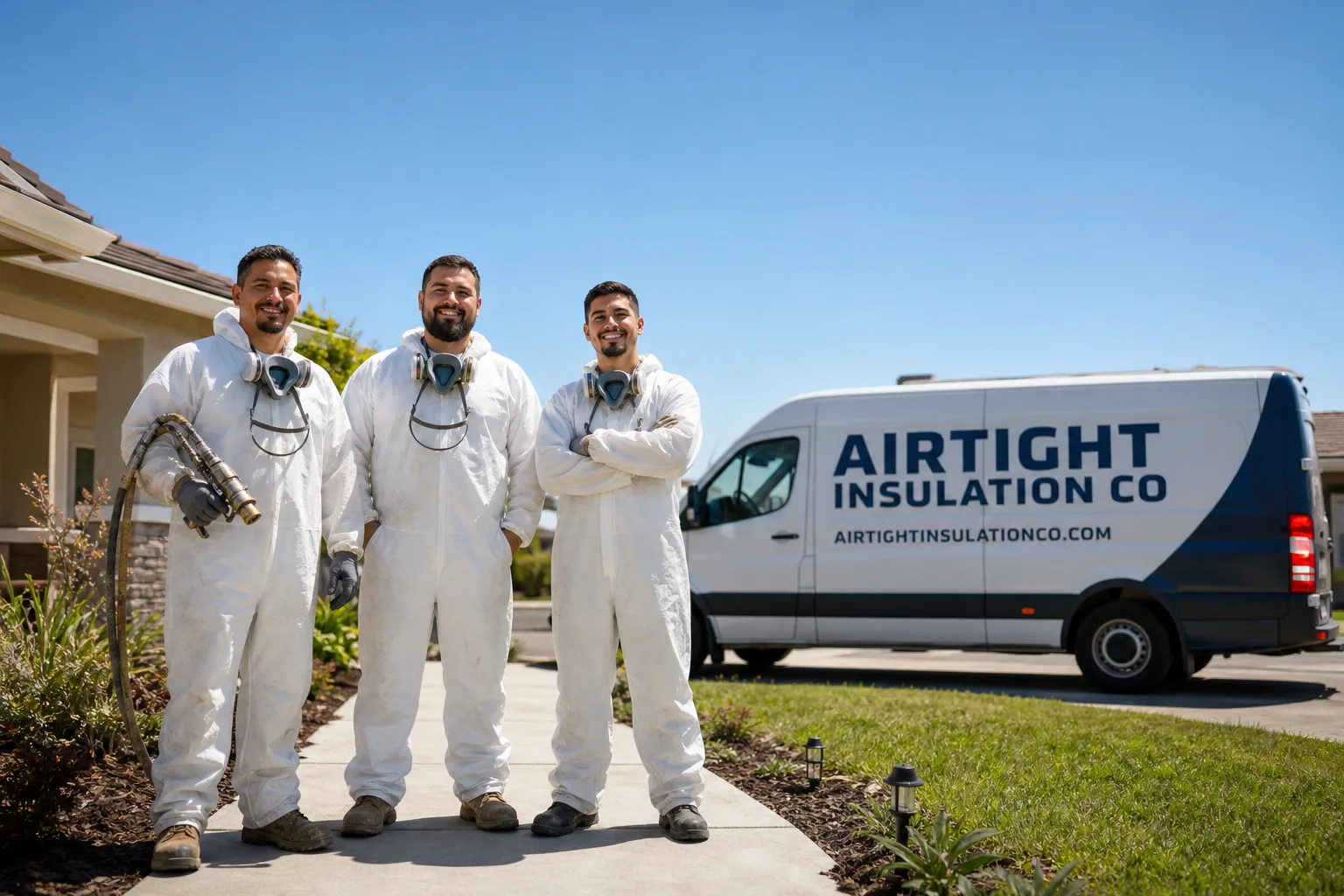
Fast, Reliable Spray Foam Insulation Across Lomita
Spray foam insulation in Lomita costs most homeowners between $1.45 and $3.10 per board foot installed, and a typical 1,200-square-foot attic project in the 90717 ZIP lands between $3,200 and $7,800 depending on open-cell versus closed-cell and how much legacy material has to be removed first. That’s the honest range. What separates a good Lomita foam job from a regrettable one isn’t the product, it’s whether the installer checked for old vermiculite, old wiring, and marine-layer moisture before spraying. We’re Airtight Insulation Co, led by Ruben Acosta, and we work in Lomita weekly, so we don’t guess at what’s behind your attic access panel. Call (833) 390-7079 for a free estimate that actually looks at what’s up there.
Why Airtight Insulation Co Is Lomita’s Preferred Spray Foam Insulation Company
We’ve worked enough homes between Lomita Boulevard, Oak Street, and the quiet blocks south of 244th Street to know what a 1951 stucco bungalow hides above its original tongue-and-groove ceilings. Ruben Acosta built this company around one principle: diagnose the real problem before recommending a product. That’s why we carry eight manufacturer brands, including Icynene and Demilec for open- and closed-cell spray foam, instead of pushing whatever’s in the warehouse. In Lomita, that matters more than almost anywhere else. The housing stock is old enough that the wrong recommendation, spraying foam over settled rock wool or around knob-and-tube wiring, turns into a problem you pay for twice.
Our crews respond to Lomita calls within 24 to 48 hours for estimates, and we quote every job with the attic opened and inspected, not from a satellite image. We don’t hardcode a single material to every house. We let the job pick the product. That’s the eight-brands, one-contractor approach: if closed-cell foam is right for your rim joists and a ventilated blown-in cellulose top-up is right for your attic floor, you get that recommendation, not a foam package you didn’t need. The goal is performance you can feel, which in Lomita means a bedroom that stops cooking on July afternoons and a hallway that doesn’t smell musty when the marine layer sits for a week.
Garage Spray Foam Insulation in Lomita
Garage spray foam insulation in Lomita is one of the highest-impact jobs a homeowner can do on a small tract house, especially on the low-pitch roofs that bake against south and west sun exposure all afternoon. The garage in a Lomita bungalow is rarely just a parking spot. It’s storage, a workshop, sometimes a home gym or a band room. When that uninsulated or half-insulated garage is attached to the house, it acts as a heat engine that radiates into the living space through a single uninsulated interior wall. Spraying closed-cell foam against the garage ceiling and the shared wall between garage and house cuts that heat transfer at the source. In terms of cost, garage spray foam in Lomita generally runs $1,800 to $4,200 for a standard single-car or compact two-car garage, with tougher jobs, old wiring, or complete cavity treatments pushing closer to $5,000.
Attached Garage Ceilings and Heat Load
Lomita’s post-WWII tracts were built fast. Most garages never got more than a scattering of fiberglass batts, and many have none at all. On a 90-degree September afternoon, a south-facing garage ceiling can hit 130 degrees, and that heat migrates. Foam on the garage ceiling, sealed to the attic plane, changes the thermal boundary. Ruben Acosta’s crews have measured interior garage temperature drops of 15 to 20 degrees after a proper closed-cell application.
Air Sealing the Shared Wall First
Before we spray the garage, we seal the penetrations, outlet boxes, and sill plates on the shared wall. Foam without air sealing is just decoration in an older Lomita home because the air leaks carry moisture and heat faster than the insulation can stop. We treat the garage as part of the house envelope, not as an accessory space.
Closed Cell Spray Foam Insulation in Lomita
Closed cell spray foam insulation in Lomita is the material we recommend most often for rim joists, crawlspace walls, and the underside of roof decks where marine-layer moisture and limited clearance make open-cell or batts a gamble. Closed-cell foam is an air barrier, a vapor retarder, and a high-R-per-inch insulator all in one, roughly R-6.5 to R-7 per inch, and it adds structural rigidity to older wood framing. Lomita’s combination of persistent onshore humidity and strong afternoon sun on low-pitch roofs means a wrong choice in a sealed assembly traps moisture against aging plywood and rafters. Closed-cell’s resistance to that moisture pathway keeps the assembly dry when ventilation is minimal. Closed-cell spray foam pricing in Lomita usually lands between $2.25 and $3.10 per board foot, so a full unvented roof deck on a 1,100-square-foot bungalow can run $8,500 to $14,000, while a targeted rim-joist sealing job stays in the $1,200 to $2,800 range.
When Closed-Cell Beats Open-Cell in a Lomita Attic
Open-cell is cheaper per board foot and works well in vented attics where the roof is in good shape. But on a low-pitch 1950s roof with limited ventilation and marine-layer mornings, open-cell can absorb and hold moisture. Closed-cell doesn’t. In the tight attics off Narbonne Avenue and east of the 110 freeway, closed-cell gives you the air seal and the moisture resistance in one pass, which matters when access is too cramped for separate vapor-barrier work.
Rim Joist and Crawlspace Work
Most Lomita bungalows sit on raised foundations with vented crawlspaces that leak conditioned air through unsealed rim joists. Closed-cell foam applied to the rim joist band, typically one to two inches, stops the stack effect that pulls hot attic air out while pulling damp crawlspace air up. This is one of the most cost-effective sealing jobs we do, and it’s especially relevant for post-WWII frames where the sill plate was never sealed.
Trusted Brands We Service in Lomita
We install Icynene open-cell products and Demilec closed-cell formulations because both brands have decades of field data and rigid installation specs, which matters when a job involves a 1952 attic with legacy wiring. We also work with Owens Corning and GreenFiber for hybrid approaches, like sprayed foam at the roofline plus a cellulose top-up over an assessed attic floor. Because we stock and service multiple brands, Lomita customers don’t wait for weeks on a specific product. The right material for your specific situation gets ordered and installed on schedule, not on a manufacturer’s backorder calendar.
Common Spray Foam Insulation Problems We See in Lomita Homes
- Vermiculite discovered mid-job. In the tracts off Lomita Boulevard and near the old Pacific Electric right-of-way, we regularly find original 1950s vermiculite. It has to be tested before any spray foam work proceeds because the old Libby-mine material contained asbestos. Testing is fast, and until results come back, no one touches the attic.
- Settled rock wool at half depth. Homes built between 1945 and 1965 often have original rock wool that’s compressed to half its installed depth, leaving the ceiling plane under-insulated even if you spray foam at the roofline. The decision to top up or remove, and in what sequence, affects the final performance.
- Knob-and-tube or early romex in the insulation zone. Closed-cell foam can trap heat around live wiring. In older Lomita homes, we map the wiring first, keep proper clearance, and often coordinate with an electrician before spraying. Skipping this step is how foam jobs become fire risks.
- Marine-layer moisture trapped by wrong installation. Homes on the windward edge of the Palos Verdes Peninsula get cool, damp air that pushes into attic assemblies. If a less careful contractor sprays open-cell foam in an unvented roof deck without accounting for that moisture drive, the assembly can stay damp and start degrading the sheathing.
Pricing for Spray Foam Insulation in Lomita, CA
Spray foam pricing in Lomita tracks with the age and condition of the house more than the square footage alone. A clean, empty, accessible attic in a 1960s tract home gets a more predictable number than a 1949 bungalow with vermiculite testing, knob-and-tube mapping, and tight access. Here’s what we quote in the 90717 ZIP code:
- Rim joist sealing with closed-cell foam: $1,200 to $2,800
- Open-cell spray foam in a vented attic floor cavity (the mixing-space between the living area and the attic): $1.45 to $2.10 per board foot
- Closed-cell spray foam in an unvented roof deck: $2.25 to $3.10 per board foot
- Garage ceiling and shared-wall spray foam: $1,800 to $4,200
- Whole-attic closed-cell job, 1,000 to 1,400 square feet: $8,500 to $14,000
Call (833) 390-7079 and we’ll inspect the actual attic before we put a number in writing. Free estimates, no pressure, no generic R-value pitch.
We Also Serve Cities Near Lomita
We work across the South Bay and Palos Verdes Peninsula, from Lomita to Torrance, Rolling Hills Estates, West Carson, and Manhattan Beach. If you’re on the Torrance line near Sepulveda or up near the Peninsula Center, the same crew covers your project. For the full range of what our Spray Foam Insulation team installs, see the service hub page.
Serving Lomita, CA — Our Local Coverage Area
We’re based in the Lomita area and know this community well. Use the map below to see our service coverage — if you’re nearby, we can almost certainly help.
FAQs About Spray Foam Insulation in Lomita
Because original vermiculite insulation in 1950s Lomita homes came from a mine that shipped asbestos-contaminated material in that era, and you can’t tell by looking at it whether a given attic has the old stuff. Testing is cheap and fast. Spraying foam over untested vermiculite permanently entombs a potential problem and makes future remediation much more expensive. We test before we touch anything.
Sometimes, but in a Lomita attic where the rock wool has settled to half depth, spraying foam over a compromised base means the lower half of the thermal layer is still missing and you’ve sealed the upper portion in place. The better sequence in most of the post-WWII bungalows we see is to assess and remove or top up the old material first, then foam the plane that matters, whether that’s the attic floor, the roofline, or the rim joist. Call (833) 390-7079 and we’ll tell you what’s actually up there.
Lomita’s onshore marine air pushes moisture into attics and walls from the outside, especially during June-gloom mornings and overcast stretches. In unvented roof decks, that moisture has nowhere to go. Closed-cell foam doubles as a vapor retarder, so it prevents that marine moisture from wetting the sheathing, which is why we specify it on the underside of roof decks and on rim joists more often in Lomita than in drier inland areas.
Knob-and-tube and early romex run through most of the original Lomita housing stock, and closed-cell foam can trap heat against that wiring if it’s sprayed directly around it. We map the circuits before we foam, keep the foam clear of active wiring with proper clearance, and if the wiring is deteriorated, we recommend an electrician before anything gets sealed. It adds a step. It’s also the difference between a safe install and a risky one. Call (833) 390-7079 and we’ll walk you through what we see.
Yes, and in most Lomita tract homes the garage is one of the fastest paybacks you’ll find because it’s directly coupled to the house through one shared wall, often uninsulated, and a garage ceiling that acts as a radiator. Sealing and foaming a single-car garage ceiling and the shared wall usually runs $1,800 to $4,200 and cuts the heat load on the adjacent room during summer afternoons. The smaller the garage, the simpler the job, which is why Lomita’s compact 1950s garages often respond better to foam than newer oversized garages.
Contact Airtight Insulation Co in Lomita
If your Lomita home is losing the fight against afternoon heat, marine-layer moisture, or an attic full of fifty-year-old unknowns, we will open it up, look at it, and tell you what actually needs to happen, whether that’s closed-cell at the roofline, garage foam, rim-joist sealing, or a hybrid approach. Estimates are free and the recommendation isn’t predetermined by what’s in our truck. Call (833) 390-7079 today and ask for Ruben Acosta’s team.
Written by Ruben Acosta, Owner at Airtight Insulation Co, serving Lomita and the South Bay with diagnostic-first insulation since the company’s founding.