
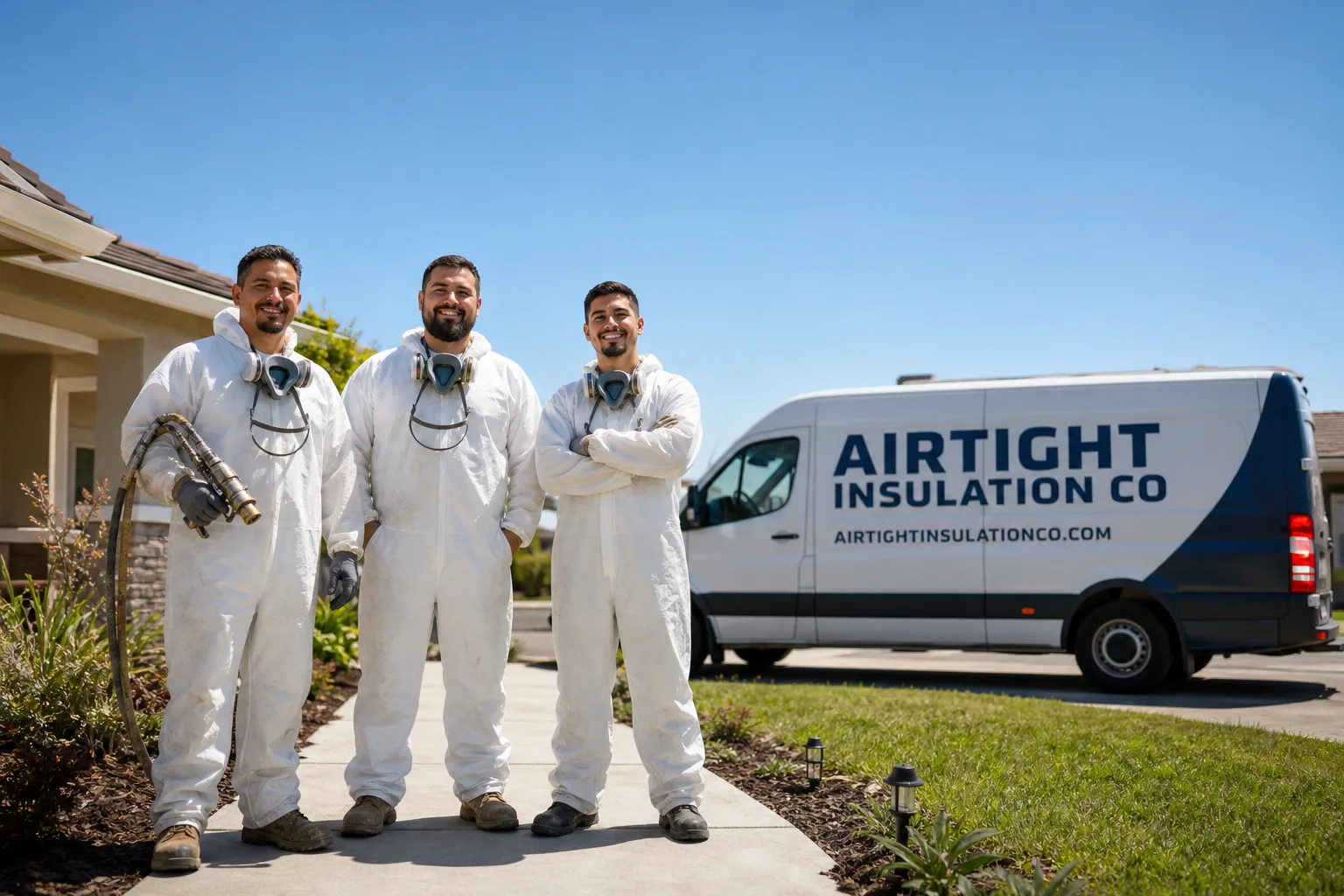
Fast, Reliable Spray Foam Insulation Across East Pasadena
Spray foam insulation in East Pasadena works harder than it does almost anywhere else in Los Angeles County. That’s because attics here routinely hit 140°F in July and August, and Santa Ana winds push fine canyon grit through every unsealed gap in a roofline. If you’ve noticed upstairs rooms that never cool down, dust accumulating on attic joists, or energy bills that climb five months straight, your insulation is telling you something. Our crews know the 91107 housing stock: the 1950s and 60s ranches off Foothill Blvd, the low-pitch roofs along Sierra Madre Villa Ave, the older framing that can’t handle off-the-shelf product specs. Call us at (833) 390-7079 and we’ll look before we recommend anything.
Why Airtight Insulation Co Is East Pasadena’s Preferred Spray Foam Insulation Company
Most insulation contractors treat East Pasadena like any other inland suburb. We don’t, because the physics here are different. Ruben Acosta has walked dozens of attics in the older tracts between Foothill and Orange Grove, and the failure pattern is consistent: original fiberglass batts break down in the dry heat, top plates leak air, and dust from the Eaton Wash corridor and foothill canyons settles into every seam. That’s why our Spray Foam Insulation team specifies closed-cell formulations for East Pasadena roof lines instead of defaulting to whatever’s on the truck.
We carry two dedicated spray foam brands, Icynene and Demilec, and we stock both open-cell and closed-cell products so the job picks the product, not the other way around. When a 1960s ranch off Sierra Madre Villa Ave needs air sealing and thermal separation, we have the material for it. That range is why homeowners in East Pasadena call us after another contractor gave them a single-product quote that didn’t address their actual problem.
Spray Foam Attic Insulation in East Pasadena
Spray Foam Attic Insulation in East Pasadena has to solve for two forces at once: 100°F-plus summer heat radiating through the roof deck, and fine dust that Santa Ana winds drive through every crack in the framing. Standard half-pound open-cell foam can soften and off-gas when deck temperatures sit above 140°F for hours at a stretch. We’ve seen it pull away from rafters after a few summers, leaving the exact gaps the homeowner paid to close. For unconditioned attics here, we typically recommend heat-stabilized closed-cell foam from Demilec on the roofline, which holds its structure in the heat and blocks dust at the same time. A full attic treatment on a 1,200-square-foot ranch in East Pasadena runs $4,800 to $7,200 depending on access and existing insulation removal.
Air Sealing the Top Plates
Before any foam goes down, the top plates, electrical penetrations, and plumbing chases get sealed. Those are where hot canyon air enters and where cooled air leaks out. In East Pasadena’s older homes, we’ve found top plates with eighth-inch gaps that add up to the equivalent of a small window left open all summer.
Roof Deck and Rafter Coverage
When the attic is unfinished and the homeowner wants storage space or ductwork replacement, coating the underside of the roof deck makes the whole attic part of the conditioned envelope. It’s a bigger investment, but it’s often the difference between a comfortable 78°F upstairs and a bedroom that hits 85°F by 3 p.m.
Spray Foam Wall Insulation in East Pasadena
Spray Foam Wall Insulation in East Pasadena addresses what batt insulation can’t: the irregular stud cavities, old framing gaps, and pest access points common in 1950s and 60s wood-frame construction. Many of the single-story homes in 91107 have original stucco over open stud bays with nothing behind them but a thin layer of paper-faced fiberglass that has settled and compacted. Closed-cell foam fills the cavity completely, adds structural rigidity, and creates an air barrier that fiberglass simply cannot. Wall spray foam runs $2.80 to $4.50 per square foot of wall area in East Pasadena, more if old wiring rerouting is required first.
Closed-Cell for Exterior Walls
We specify closed-cell in exterior walls for one reason: East Pasadena’s hot-dry summers create a vapor drive that pushes moisture inward, and closed-cell’s low permeability handles that cycle without degrading. It also keeps dust and pest intrusion to zero in the wall cavity.
Older Tract Home Retrofit
For an existing East Pasadena home, wall retrofits are more involved than new construction. We often work cavity by cavity from the exterior, removing small siding sections, filling, and reinstalling. It’s precise work, and it’s one of the reasons homeowners on the older Foothill Blvd tracts call us specifically for this job.
Trusted Brands We Service in East Pasadena
We stock and install Icynene and Demilec spray foam products in East Pasadena, and we’re one of the few Los Angeles-area contractors carrying both. That matters because open-cell and closed-cell are not interchangeable, and East Pasadena’s attic conditions demand the right one. For homeowners who prefer a blown-in or batt solution instead of foam, we also work with Owens Corning, Johns Manville, and GreenFiber products. The point is fit, not brand loyalty. We let the job pick the product.
Common Spray Foam Insulation Problems We See in East Pasadena Homes
- Open-cell foam shrinking off rafters: Repeated 140°F attic heat cycling causes standard open-cell foam to pull away from wood framing, leaving slivers of daylight and dust that compound over time. We see this most often in homes that got “spray foam” from a contractor who didn’t account for inland valley temperatures.
- Knob-and-tube wiring hidden by previous foam jobs: In 1950s ranches where the original wiring is still active, foam applied directly over the wiring traps heat and creates a fire hazard. We inspect and reroute before spraying; if your last contractor didn’t, you should have it looked at.
- Dust contamination ruining foam adhesion: The fine grit that blows in from the Eaton Wash area and the foothills settles on attic wood and compromises the chemical bond between foam and substrate. We prep surfaces thoroughly, because foam that doesn’t bond doesn’t seal anything.
- Attic temperatures staying stubbornly high: Insulation alone won’t fix an attic that’s pushing 150°F. You need radiant-barrier function and air sealing. If your attic is still hot after the foam went in, the roofline wasn’t treated properly, or the foam was the wrong density for the job.
Pricing for Spray Foam Insulation in East Pasadena, CA
Closed-cell attic roof deck treatments in East Pasadena run $5,200 to $7,800 for a typical 1,100 to 1,500-square-foot single-story home. Wall cavity injection with closed-cell lands between $2,800 and $4,500 per exterior wall line. Open-cell air sealing for attics runs $2,400 to $3,800. What moves the numbers: access clearance, existing insulation removal, wiring condition, and whether you’re treating the roofline or just the attic floor. We’ll walk the space and give you a firm number before any work begins. Call (833) 390-7079 for a free estimate, and we’ll come out to your East Pasadena home within the week.
We Also Serve Cities Near East Pasadena
Our crews cover the entire west San Gabriel Valley. We run jobs in Sierra Madre, San Marino, Pasadena, and Arcadia every week, and our familiarity with the older housing stock in those areas is the same as it is in East Pasadena. Read more about our work across the region at Spray Foam Insulation in East Pasadena.
Serving East Pasadena, CA — Our Local Coverage Area
We’re based in the East Pasadena area and know this community well. Use the map below to see our service coverage — if you’re nearby, we can almost certainly help.
FAQs About Spray Foam Insulation in East Pasadena
Yes, when the right foam is specified. Closed-cell spray foam from Demilec or Icynene holds its structure at the 140°F-plus roof deck temperatures common in East Pasadena, and it doesn’t pull away from rafters the way standard open-cell foam can after a few summers. Santa Ana winds and canyon dust stay out because closed-cell is also an air barrier. Open-cell foam can work in wall cavities, but for East Pasadena roof lines we recommend heat-stabilized closed-cell. Call (833) 390-7079 and we’ll tell you what your attic actually needs.
Yes, after the wiring is assessed. In East Pasadena’s older tract homes, we inspect every circuit before spraying. If knob-and-tube is still active, it must be rerouted or isolated before foam touches it, because foam traps heat around the wires and creates a code violation and fire risk. Ruben Acosta has handled this exact scenario on multiple ranches in 91107, and we coordinate with a licensed electrician to keep the job moving. Estimates are free.
By sealing the entry points. The dust that blows in from the Eaton Wash corridor and the foothill canyons enters through top plates, wire penetrations, and gaps where framing meets stucco. Closed-cell spray foam fills those gaps completely, so the dust never gets a path. Batt insulation just filters it; foam blocks it. That’s the difference between filling and sealing.
For an unfinished attic in East Pasadena, closed-cell spray foam on the roof deck is usually the right move if you want the space usable or want to protect ductwork from 140°F heat. It air-seals, insulates, and blocks dust all in one pass. If you’re leaving the attic unconditioned and only treating the floor over the living space, open-cell air sealing at the top plates with blown-in cellulose on the floor is a cost-effective alternative. We’ll assess your specific roof pitch and framing before recommending. Free estimates at (833) 390-7079.
Yes. Wall cavity spray foam is one of our more common East Pasadena jobs, especially in the 1950s and 60s stucco ranches where original batt insulation has settled or was never installed properly. Closed-cell foam fills the irregular stud bays, air-seals the cavity, and stops dust and pest intrusion. The work is done cavity by cavity from the exterior with minimal disruption. Call us for a wall-specific quote.
Written by Ruben Acosta, Owner at Airtight Insulation Co, serving East Pasadena and the surrounding San Gabriel Valley.