
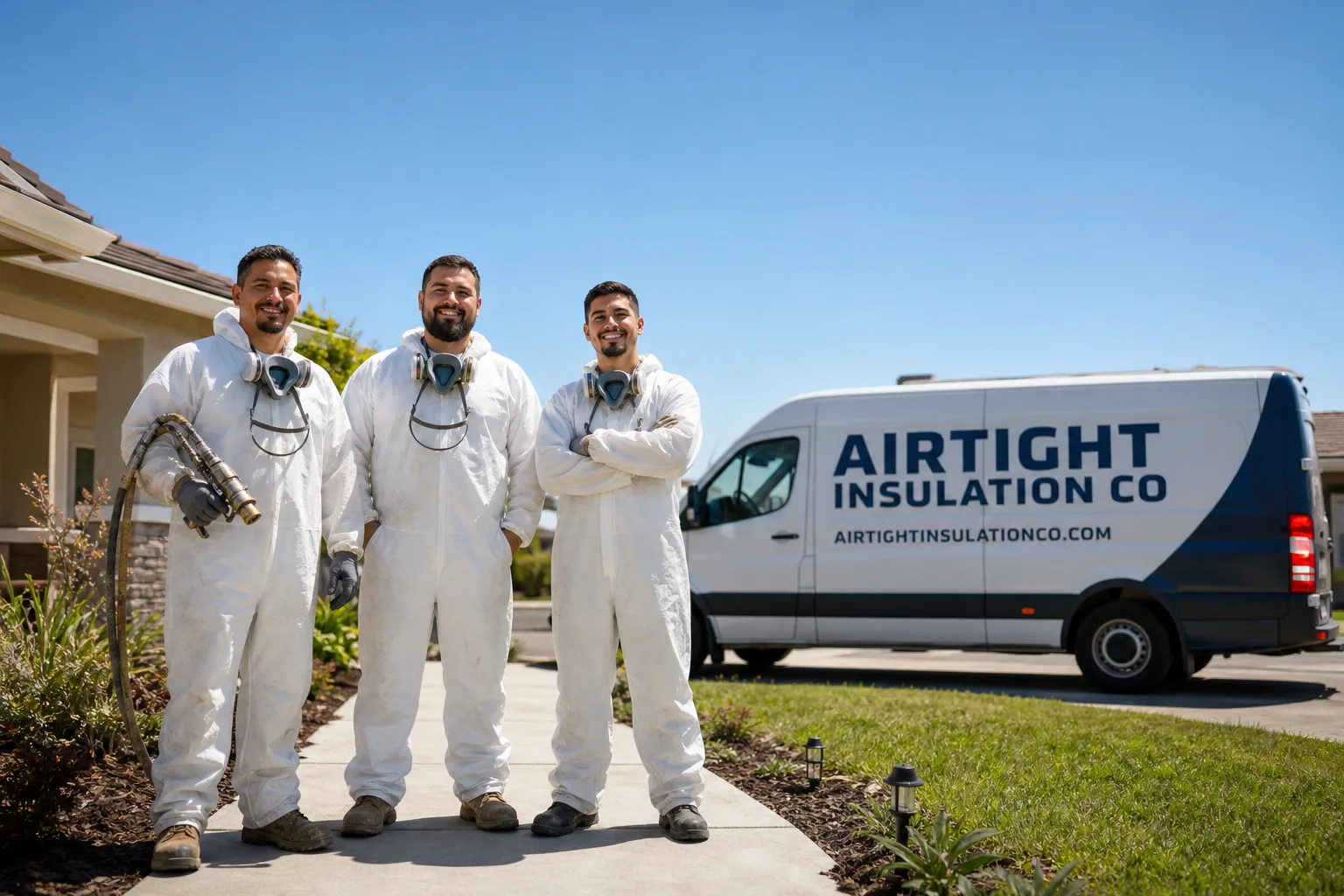
Fast, Reliable Spray Foam Insulation Across Compton
Spray foam insulation in Compton usually means retrofitting a 1940s-to-60s stucco tract home where the original attic fill has settled to nearly nothing. Most Compton attics we open still read as “insulated” on paper but hold only a few compressed inches of degraded batt or newspaper-era fill. Airtight Insulation Co repairs that gap properly: we air-seal the attic floor and top plates, then apply open- or closed-cell foam matched to the specific roof deck and marine-layer conditions in your home. Call (833) 390-7079 for a free estimate in Compton, and we’ll have a crew out to your block within one business day.
Why Airtight Insulation Co Is Compton’s Preferred Spray Foam Insulation Company
The big difference in Compton is that most insulation contractors don’t know what’s under the roof of a 1950s tract house off Rosecrans Avenue or Long Beach Boulevard. We do. Ruben Acosta has worked spray foam in Compton’s 90220, 90222, and 90223 corridors long enough to recognize the layered failure pattern common to these postwar homes: original fill compressed under multiple re-roofs, no vapor management on low-pitch decks, and moisture that condenses when attic air hits cold framing at the marine layer’s dew point. That’s why the crew doesn’t just spray foam and leave. We diagnose the cavity first, then let the job pick the product.
Compton homeowners routinely tell us the same story: energy bills climbing, bedrooms at the west end of the house baking by 3pm, and a persistent mustiness in the attic they can’t source. Our work fixes those symptoms at the cause. We carry open-cell Icynene for sound and air-sealing on interior assemblies, closed-cell Demilec for low-pitch roof decks and rim joists where space and moisture resistance matter, and GreenFiber blown-in for Compton clients who want a recycled-content retrofit over a sealed attic floor. Eight brands, one contractor. The recommendation follows the house, not our inventory.
We respond to Compton service calls within one business day, and our trucks are stocked with the foam kits, spray guns, and ventilation components these older homes commonly need. No driving back to a yard in Las Flores mid-job for a fitting. If you’re on a block of 1940s tract homes near Willowbrook, you’re not a special dispatch for us. You’re the daily work.
Open Cell Spray Foam in Compton
Open Cell Spray Foam is the most common retrofit we install in Compton attic cavities on 1940s and 50s homes, because it expands to fill voids around settled legacy insulation and air-seals the ceiling plane in one pass. In most Compton tract homes, the existing batt or blown fill has dropped to a third of its labeled depth, which means the attic is effectively uninsulated. We don’t spray over that compressed mess. We pull it, air-seal the top plates and penetrations, then apply open-cell foam at the depth the cavity actually needs. Open-cell is also the right choice when the priority is stopping air movement and cutting late-summer radiant heat gain through the ceiling, not adding an inch of rigid thermal break against groundwater or flood conditions.
The decision between open-cell and closed-cell in Compton is usually driven by the roof, not the wall. On vented attics with a working ridge or gable setup, open-cell on the attic floor does the job for less material cost. On unvented, low-pitch decks where marine-layer condensation sits against the framing, closed-cell is the better call. We’ll show you the difference on your own roof plan before we quote it.
Typical open-cell spray foam work in a Compton attic runs $1,800 to $4,200 depending on square footage and how much legacy fill has to be removed first. A full house with open cell on the attic floor and rim joists might land between $6,500 and $11,000. These are real ranges for Compton’s housing stock, and the estimate we give you includes the removal and disposal of the old insulation. No surprise line items after we open the hatch.
Air Sealing and the Attic Floor
Open-cell does its best work in Compton when it’s paired with real air sealing. The top plates, plumbing penetrations, and electrical drops in these older homes leak enough air to make a 50-degree attic push warm air into the house all morning during the marine layer. We seal those gaps before foam goes in.
The result is a house that stops breathing through the ceiling. Rooms in the 90222 corridor near the Compton Airport see the biggest summer comfort jump, because that’s where afternoon sun hits the roof deck hardest.
When the Legacy Fill Has Settled
If your Compton attic still has original rock wool or newspaper-era fill, open-cell is not a cover-up job. We remove the settled material first. Then we inspect the deck, check for rat runs and old roof leaks, and spray a clean, continuous layer.
Skipping the removal step is the number one reason foam delaminates in these attics. The old dust and friable fibers prevent adhesion, and the homeowner gets a failed pass that has to be stripped and redone. We don’t do it twice.
Spray Foam Insulation Contractors in Compton
Spray Foam Insulation Contractors in Compton are not all cut from the same cloth. Many are general insulation crews who spray open-cell on everything and call it done. Airtight Insulation Co runs a different playbook. Ruben Acosta built this company around the idea that the material has to match the application, and Compton’s postwar housing stock tests that principle harder than most. We’re the contractor you call when the job involves a low-pitch roof deck, settled fill buried under two re-roofs, or a detached garage with a flat roof that radiates heat into the house all evening. We diagnose first, recommend second, and spray third.
Our crew carries both Icynene and Demilec foam systems, which means we can quote open-cell for an attic floor and closed-cell for a rim joist or roof deck on the same job. That’s rare. Most Compton contractors are locked into one brand and one density, so the recommendation bends toward what’s on the truck. Ours doesn’t.
Roof Deck and Rim Joist Work
Low-pitch and flat-ish roof decks in Compton’s older tracts are a genuine moisture trap. The marine layer rolls in around 2am and sits against the roof sheathing until late morning. If foam is applied without a plan for that condensation, the moisture stays trapped and rots the framing over time.
We use closed-cell Demilec on those decks because it blocks vapor movement directly. Then we ventilate or dehumidify the remaining space so the moisture has somewhere to go. It’s a detail most crews skip, and it’s the difference between a foam job that lasts 15 years and one that sends you back to Google in three.
Retrofit Work on Mid-Century Tracts
Compton’s 1940s-60s homes share a signature: stucco on wood frame, detached garages, low-pitch roofs, and decades of accumulated re-roofing layers. That last part matters. Every new roof adds weight and bulk to the deck, and the old insulation underneath gets pressed down over time.
When we open an attic in a 1952 home off Willowbrook Avenue, we expect to find the original batt or fill compressed to a third of its rated depth. The homeowner thinks they have R-30. They have maybe R-8, and it’s humid. Our retrofit fixes the actual condition, not the label.
Trusted Brands We Service in Compton
We stock and install Demilec closed-cell and open-cell spray foam, Icynene open-cell foam, and GreenFiber cellulose for Compton projects that need a blown-in complement to a spray foam air seal. If a job calls for mineral wool or fiberglass, we have access to Owens Corning and Johns Manville product lines as well. That gives a Compton homeowner something they can’t get from a single-brand contractor: a real comparison of what each material does for their specific attic, rim joist, or roof deck. We don’t default to one foam density because it’s what we bought in bulk. We let the job pick the product, and we keep enough material on the truck to do exactly that.
Common Spray Foam Insulation Problems We See in Compton Homes
- Settled legacy fill under repeated re-roofs. The original batt or newspaper fill in Compton’s 1940s-60s attics gets compressed under every new roof layer. A technician pulling a sample often finds 30 to 40 percent of the labeled depth gone, meaning the attic is effectively uninsulated even though it looks full from the hatch.
- Marine-layer condensation on unvented, low-pitch decks. Compton’s morning marine layer is the real enemy, not cold. On flat-ish or low-pitch postwar roof decks without proper venting, moisture condenses on the underside of the sheathing and sits against the framing. Spray foam without a moisture plan traps that water and rots the deck from the inside.
- Poor adhesion over dirty or friable deck surfaces. Older Compton attics carry decades of dust, rat droppings, and crumbling legacy insulation. Spraying foam directly over that surface guarantees delamination within a few years. The deck has to be cleaned and prepped first, and many crews skip that step to save time.
- Detached garages with no insulation plan at all. Most postwar Compton homes have detached garages that were never insulated, so on hot afternoons the garage becomes a heat box that radiates into the house through the shared wall or breezeway. That’s a separate but solvable insulation problem specific to this housing stock.
Pricing for Spray Foam Insulation in Compton, CA
Here’s what Compton homeowners should budget. Open-cell spray foam on an attic floor in a standard single-story tract home runs $1,800 to $4,200, including removal of the old compressed fill. Closed-cell foam on a low-pitch roof deck runs $3,500 to $7,500 depending on deck area and access. Rim joist work, which most drafty Compton homes need, lands between $1,200 and $2,800 for a typical single-story footprint. A full-house retrofit combining attic floor air sealing, open-cell foam, and rim joist treatment usually falls between $6,500 and $11,000. The main variables are square footage, roof geometry, and how much legacy insulation has to come out first. We provide line-item estimates before any work starts, and the estimate is free. Call (833) 390-7079 to schedule a walkthrough.
We Also Serve Cities Near Compton
Our crews work Compton daily and also run service to Spray Foam Insulation in Compton‘s neighboring communities, including East Rancho Dominguez, West Rancho Dominguez, Carson, and Gardena. If you own a rental property or a family home in one of those areas, the same assessment and material-matching process applies. Spray Foam Insulation done right travels five miles without losing quality.
Serving Compton, CA — Our Local Coverage Area
We’re based in the Compton area and know this community well. Use the map below to see our service coverage — if you’re nearby, we can almost certainly help.
FAQs About Spray Foam Insulation in Compton
Because the insulation has settled. In Compton’s 1940s-60s tract homes, the original batt or newspaper fill has been compressed under repeated re-roof and re-stucco layers to a fraction of its rated R-value, so the attic is effectively uninsulated. The material is still there physically, but it’s not doing its job. The fix starts with pulling a sample, measuring the actual depth, and deciding between removal and re-foam or a fresh blown-in pass after air sealing. Call (833) 390-7079 for a free attic assessment and we’ll tell you what’s actually up there.
Yes, but only with a moisture plan. Low-pitch and flat-ish postwar roof decks in Compton collect marine-layer condensation against the sheathing every morning. Closed-cell Demilec foam blocks that vapor movement and protects the framing, while open-cell applied without thinking about moisture can trap water and rot the deck. We specify the foam based on how your roof actually behaves, not on a generic formula.
No, and a contractor who says yes is setting you up for delamination. Old fiberglass batts, rock wool, and newspaper-era fill in Compton attics are dusty, friable, and uneven, which means foam won’t bond to the deck or ceiling plane. We remove the legacy fill, inspect the deck, air-seal the penetrations, and then spray clean. That’s why our quotes include removal, not just material.
We stock and install Demilec closed-cell and open-cell, Icynene open-cell, and GreenFiber cellulose for blown-in complements. That gives us the ability to match the product to your attic, rim joist, or roof deck instead of forcing one density on every situation. Most Compton jobs use Icynene on the attic floor and Demilec on low-pitch decks and rim joists.
Yes, and the garage is often the highest-value part of the job. Most postwar Compton homes have detached garages that were never insulated and act as heat boxes all afternoon. Spraying open-cell on the garage ceiling and the shared wall with the house cuts that radiant load dramatically. The attic retrofit and rim joist treatment on the main house deliver the rest. For an exact price on your specific tract layout, call (833) 390-7079. Estimates are free and we’ll walk the property with you.
Contact Airtight Insulation Co for spray foam work in Compton. We’ll send a crew to your home, pull attic samples, inspect the roof deck and rim joists, and give you a line-item estimate that matches your house, not a template. Call (833) 390-7079 today.
Written by Ruben Acosta, Owner at Airtight Insulation Co, serving Compton and surrounding areas.