
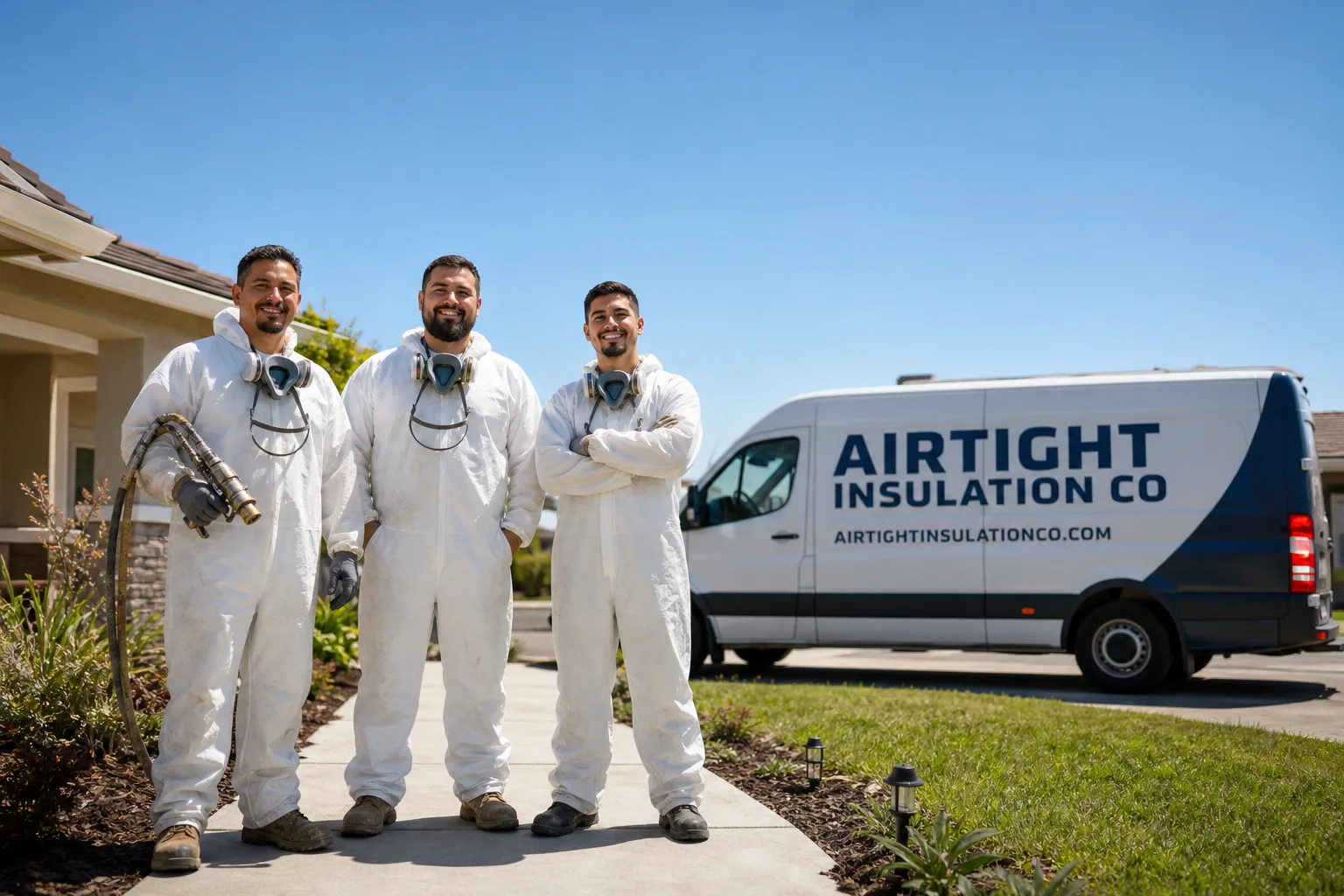
Fast, Reliable Spray Foam Insulation Across West Covina
Spray foam insulation in West Covina typically costs $2.80 to $6.50 per square foot installed, depending on whether the job calls for open-cell or closed-cell foam, and most wall cavity injection projects we take on are completed in one to two days. If you’re in a 1950s or ’60s ranch off Amar Road or up near the 10 freeway and your air conditioner runs constantly from June through September, the problem is rarely your HVAC unit. It’s the building envelope. We’re Airtight Insulation Co, and we’ve been retrofitting West Covina homes long enough to know that the stucco-over-open-stud construction in this city creates air leaks that no batt insulation will ever fix. Call (833) 390-7079 and we’ll tell you exactly what’s happening inside your walls.
Why Airtight Insulation Co Is West Covina’s Preferred Spray Foam Insulation Company
We stock eight manufacturer brands and let the job pick the product. That means when we walk into a mid-century ranch in the 91791 ZIP and find wall cavities with no sheathing, we’re not limited to whatever’s on the truck. We reach for Icynene open-cell when the goal is air sealing and sound dampening. We use Demilec closed-cell when a rim joist needs structural rigidity and moisture resistance. Ruben Acosta built this company around a simple rule: seal it, not just fill it. That’s why our crews spend more time finding the gaps than filling the obvious spaces.
West Covina homeowners call us after other insulation jobs underdeliver. A common story: someone blew cellulose into the attic, energy bills barely moved, and a thermal camera later revealed the walls were doing nothing. That’s the difference between filling and sealing. We come out, diagnose, and give you a straight answer. If spray foam isn’t the right material for your specific situation, we’ll tell you that too. Mineral wool, fiberglass, or blown-in cellulose might serve you better. That’s what having eight brands actually means.
Response Time and Coverage Across West Covina
We dispatch to all four West Covina ZIP codes: 91790, 91791, 91792, and 91793. Most estimates happen within 48 hours of your call. Because we work throughout the San Gabriel Valley, a project off Citrus Avenue near the mall doesn’t get pushed to next week just because our schedule is full. We plan routes with West Covina’s traffic patterns in mind, which means early-morning arrivals if you’re near the 10 on-ramps and we know the permit windows for the HOA-governed tracts.
Local Knowledge That Shows Up in Our Work
The homes off Amar Road and Merced Avenue were built fast. That’s not a knock, it’s just what happened in the 1950s and ’60s when West Covina boomed as a commuter suburb. Builders didn’t insulate walls. Exterior sheathing was often skipped entirely, with stucco applied over open stud bays. When we inspect an attic here, we expect to find settled or missing insulation, open rim joist cavities, and soffit vents blocked by a fresh coat of paint. None of that surprises our crews, and all of it gets addressed in the scope of work.
Spray Foam Wall Insulation in West Covina
Spray Foam Wall Insulation in West Covina means injecting foam into existing wall cavities without removing the stucco. On the ranch tracts built between 1950 and 1975, many exterior walls are stucco directly over open stud bays, no sheathing, no house wrap. Original fiberglass batts, where installed at all, have compressed, sagged, and pulled away from the stucco, leaving a continuous air channel that connects the attic to the living space. Our crews drill small access holes, inject foam that expands into every void, and seal the cavity so air can’t move. Wall injection on a typical 1,200-square-foot West Covina ranch runs $4,800 to $9,600 for full exterior coverage.
Injection Without the Mess
We don’t tear off stucco. The injection process works from the inside or outside depending on your wall finish and furniture layout, and the foam bonds directly to the back of the stucco, filling stud bays completely. That bond is what makes spray foam different from re-stuffing batts into a wall that has failed once already.
Why Older West Covina Walls Need Air Sealing
Fiberglass batts slow conduction. They do not stop air movement. In a stucco-over-open-stud wall, air moves freely through the stud bay itself, bypassing whatever insulation is in place. Spray foam stops the air. For West Covina summers where attic temperatures top 120°F, sealing that channel is the single highest-impact upgrade most older homes can get.
Rim Joist Spray Foam in West Covina
Rim Joist Spray Foam in West Covina tackles the space where your floor framing meets the foundation wall, typically in the garage or crawlspace. In single-story ranches with attached garages, the rim joist sits directly above the garage ceiling and often has open gaps around wiring, plumbing vents, and duct runs. Hot attic air drops into the garage, moves through those gaps, and radiates up through the floor into bedrooms. Sealing a rim joist with two inches of closed-cell Demilec foam typically costs $1,800 to $3,200 on a West Covina property, depending on linear footage and access.
What the Foam Does
Closed-cell spray foam applied to rim joists creates an air barrier and a vapor barrier in one pass. It also adds structural stiffness, which matters on older framing where the joist pockets have dried out and shifted. Most garages we seal in the 91792 ZIP take a single morning, and you’ll notice the difference in the room directly above the garage by the next hot afternoon.
Why Batts and Cans Can’t Do This Job
Rim joist cavities are irregular. Wires, nails, plumbing, doubled-up floor joists. Rigid foam board cut by hand leaves gaps. Spray foam expands into the corners and around penetrations. You get a continuous seal across every joist bay, and that’s what breaks the thermal bridge that makes rooms above garages feel 15 degrees hotter than the rest of the house.
Trusted Brands We Service in West Covina
We’re not tied to one manufacturer. Our Spray Foam Insulation team installs Icynene and Demilec foam systems, both open-cell and closed-cell, and we also carry Owens Corning, Johns Manville, Rockwool, CertainTeed, GreenFiber cellulose, and Knauf fiberglass. That means if spray foam isn’t right for a particular section of your West Covina home, we’ll say so and use the right material instead. We keep foam rigs stocked and calibrated for Southern California temperatures, so there’s no waiting on a shipment when your project is mid-scope. Eight brands, one contractor. The job picks the product.
Common Spray Foam Insulation Problems We See in West Covina Homes
- Compressed original batts in stucco-on-stud walls. Most 1950s-1970s tract homes off Vine Avenue and Lark Ellen had fiberglass stuffed into un-sheathed walls. Fifty years later it’s a one-inch mat with a two-inch air gap against the stucco, and conditioned air pours through it.
- Open rim joist cavities above attached garages. Wiring and plumbing penetrations were never sealed. The garage hits 110°F by noon, hot air moves through the joist bays, and the bedroom above never cools.
- Degraded attic insulation under radiant-heated roofs. West Covina attics hit 130°F in August. Fiberglass and settled cellulose both lose performance under that sustained heat, which is why spray foam applied to the roofline or floor deck can outperform old blown-in material.
- Blocked soffit vents in older eaves. Decades of repainting, stucco patching, and roof replacements have sealed off the passive airflow these ranches relied on. When ventilation is already compromised, closed-cell foam on the roof deck can be the better retrofit than trying to restore vents a HOA won’t let you modify.
Pricing for Spray Foam Insulation in West Covina, CA
We price by square footage of actual coverage, not by square footage of your house. Open-cell wall injection in West Covina runs $2.80 to $4.20 per square foot. Closed-cell rim joist work runs $5.00 to $7.00 per square foot, which is why a full rim joist job on a 2-car garage lands around $1,800 to $3,200. Roofline applications with closed-cell spray foam start around $4.50 per square foot and climb based on the complexity of the rafter bays. A full whole-house retrofit on a 1,400-square-foot West Covina ranch might land between $9,000 and $18,000 when walls, rim joists, and attic are included. Your estimate is free and itemized, so you’ll see exactly what’s covered, what material we’re recommending, and why. Call (833) 390-7079 to schedule one.
We Also Serve Cities Near West Covina
Most of the homes in Valinda and West Puente Valley share the same era of construction, the same stucco-over-stud walls, and the same summer attic heat we see in West Covina. We also work extensively in La Puente and Avocado Heights. If you’re anywhere in the San Gabriel Valley and the air conditioner never seems to win, call us. We’re the West Covina insulation contractor that actually explains the problem before quoting the fix.
Serving West Covina, CA — Our Local Coverage Area
We’re based in the West Covina area and know this community well. Use the map below to see our service coverage — if you’re nearby, we can almost certainly help.
FAQs About Spray Foam Insulation in West Covina
Blown-in insulation fills space but does not stop air movement, and most West Covina attics lose energy through air leaks at the top plates, recessed can lights, and plumbing chases, not through lack of fill. Spray foam seals those leak points while insulating, which is the only way to stop the convective loop that pulls 120°F attic air into your home. If your attic already has old settled insulation, adding more on top doesn’t fix the stack effect. Call (833) 390-7079 and we’ll tell you what’s actually happening in your attic before recommending a single product.
Yes, and that’s exactly what wall injection foam is designed to do. We drill small access holes through the stucco or drywall, inject Icynene open-cell foam into the stud cavities, and the foam expands to fill and seal the entire bay. The stucco stays in place. The holes are patched and painted to match. This is the standard approach for the 1950s-1970s ranches that make up much of West Covina’s housing stock.
Most HOA rules in West Covina apply to exterior modifications you can see from the street, and spray foam applied inside walls, attics, or rim joists doesn’t change your exterior appearance, so it rarely triggers design review. The exception is roofline foam, which may require a modified ventilation plan if your HOA restricts adding ridge or soffit vents. We’ve worked through enough of these to tell you upfront whether your project needs paperwork. Ruben Acosta’s crews know which of the older tracts off Amar Road and near Cortez Park have stricter architectural committees, and we’ll flag it in the estimate.
Compressed or sagging fiberglass batts in un-sheathed stucco walls are the failure we see most, but the real issue is the air channel behind them. Builders in the 1950s and ’60s skipped sheathing completely on many of these homes, so the stucco is the only thing between the stud cavity and the outside. When the batts sag, they pull away from the stucco and leave a continuous air path from the attic down into the living space. Re-fluffing batts or stuffing new ones doesn’t stop that air movement. Injection foam does, because it bonds to the stucco and fills the entire cavity.
Yes, in most cases. The old batts must come out so the foam can expand fully and bond directly to the studs and the back of the stucco. Leaving compressed fiberglass inside means the foam can’t fill the cavity completely, and you’re back to the same problem: an unsealed air channel. We remove the failed insulation as part of the wall injection scope, and we haul it away. On a 1962 ranch off Amar Road recently, the original batts were compressed to under an inch, and that’s typical of what we find in West Covina homes built before wall insulation was standard practice.
Written by Ruben Acosta, Owner at Airtight Insulation Co, serving West Covina and the San Gabriel Valley. We stock eight insulation brands and let the job pick the product.