
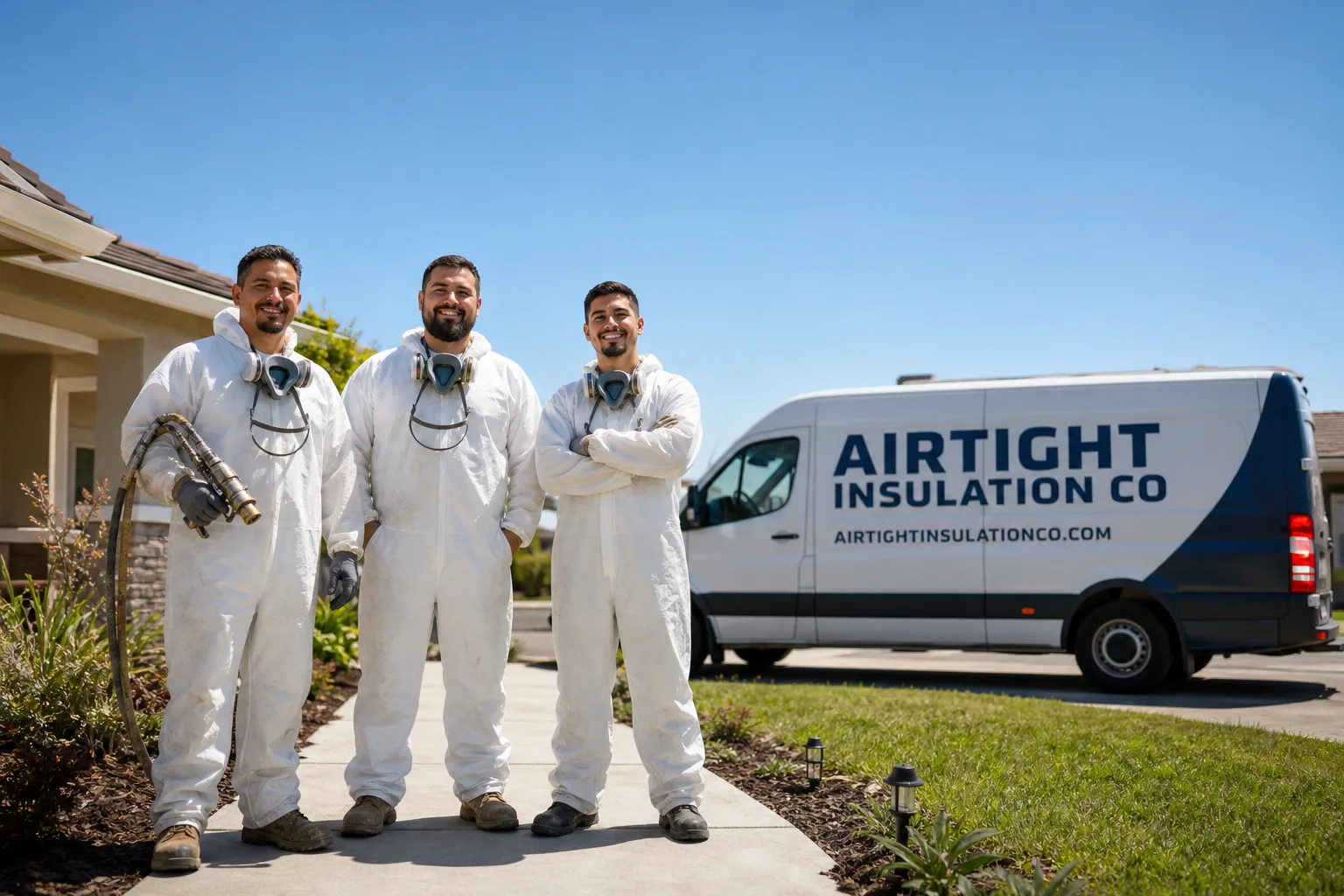
Fast, Reliable Spray Foam Insulation Across Topanga
Spray foam insulation in Topanga is rarely just about R-value. It’s about air sealing a canyon home against wind-driven embers, hot dry summers, and damp winter walls. A typical spray foam attic project in Topanga runs $2,400 – $5,800 depending on square footage and whether we’re also retrofitting ember-resistant venting. Airtight Insulation Co serves all of 90290, from Old Topanga Road up to Saddle Peak, with crews who know the terrain and the code. Call (833) 390-7079 for a free estimate.
Key takeaways:
- We quote spray foam work in Topanga within 24 – 48 hours of the site visit.
- Every attic job gets evaluated against Chapter 7A WUI venting requirements, not just insulation depth.
- We install both open-cell and closed-cell foam through Icynene and Demilec, matched to the structure.
- Free estimates, upfront pricing, and a written scope before any work begins.
Why Airtight Insulation Co Is Topanga’s Preferred Spray Foam Insulation Company
Topanga homeowners call us because we understand what a canyon house actually is: a hand-built 1960s cabin with no wall cavities, or a newer hillside build with steel moment frames and tricky roof decks. We don’t show up with one product and force it into every job. Spray Foam Insulation is one of several tools we carry, and we’re honest when another material fits better. Ruben Acosta has built the company around that honesty. We let the job pick the product, not the other way around.
Response time to Topanga is usually same-week for estimates and 5 – 10 business days for scheduled installs, depending on permit timing and scope. Reviews from Topanga customers consistently mention two things: we show up when we say we will, and we flag fire-hardening issues other contractors miss. When a home sits against chaparral on a north-facing slope, small details like soffit vent mesh and hatch weatherstripping determine whether the insulation actually performs and whether the owner keeps their insurance. That’s the standard we work to.
Spray Foam Attic Insulation in Topanga
Spray foam attic insulation in Topanga is often the finish coat over a fire-hardening assembly, not the whole job. Because Chapter 7A WUI rules require ember-resistant venting and a weatherstripped fire-rated attic hatch to keep the foam and the insurance intact, our crews routinely mask and protect open-eave soffits before spraying. Foam overspray on unprotected vents is one of the most common inspection failures we see in 90290. We plan for that from the first measurement.
A typical attic job here runs $2,400 – $5,800. The low end covers a small, accessible attic with 1,000 – 1,200 square feet of roof deck. The high end covers a larger or irregular attic with kneewalls, multiple access points, or vent retrofitting worked into the same visit.
Fire-rated access and vent retrofits
In Topanga, a foam job isn’t finished when the foam cures. We check every gable, soffit, and foundation vent that could admit an ember. Existing openings get 1/8-inch stainless mesh. The attic access hatch needs weatherstripping and a fire-rated panel. These aren’t add-ons. They’re the difference between a house that passes underwriting and one that gets dropped.
On a redwood post-and-beam cabin off Old Topanga Road, our crew found the classic canyon-cabin attic: low, irregular, reached only through a tight bedroom closet, with fiberglass batts sagging away from the roof deck and open gable vents. We sprayed Icynene closed-cell foam to seal the deck and kneewalls, then fitted the existing soffit and gable vents with 1/8-inch stainless mesh and weatherstripped the fire-rated access hatch so the foam wasn’t defeated by ember intrusion. The homeowner kept the WUI coverage after the underwriting photos were reviewed.
Old cabins with no real cavity
Many Topanga homes were built before insulation was standard. The roof deck sits directly over open framing with no thermal boundary. In those cases, closed-cell foam applied to the underside of the roof deck creates both the air seal and the insulation in one pass. We often combine that with GreenFiber blown-in cellulose where a lower-cost fill layer makes sense below the foam line. The point is a continuous thermal boundary, not a random pile of batts.
Spray Foam Wall Insulation in Topanga
Spray foam wall insulation in Topanga comes up most often in one of two situations: an owner-built addition with empty stud bays, or a retrofit where the original siding is off and we have direct access to the framing. A typical wall job runs $1,800 – $4,200 per exterior wall section, depending on cavity depth, stud spacing, and whether we’re working behind new drywall or from the exterior side. It’s never a simple “fill the cavity and walk away” job here.
North-facing canyon walls present a specific problem. Winter moisture moves through redwood and cedar framing more readily than through modern kiln-dried lumber. Skip the vapor management, and you’ll trap condensation inside the wall assembly. We map the vapor drive before choosing the foam type. In most Topanga wall retrofits, we spec closed-cell foam at 2 – 3 inches and manage the rest of the cavity with a complementary material rather than packing it full of foam and hoping for the best.
Fire-hardening wall assemblies
Chapter 7A affects walls too. When we open a Topanga wall, we look at the sheathing, the vents, and any gaps where embers could enter. Closed-cell foam can double as an air and moisture control layer when applied correctly. But the assembly still needs ignition-resistant detailing around openings. We coordinate with the owner and any general contractor on site to make sure the foam is part of a compliant assembly, not a shortcut around one.
Trusted Brands We Service in Topanga
Airtight Insulation Co stocks and installs Icynene and Demilec spray foam, so we’re not tied to a single foam chemistry or a single rep’s pitch. When a Topanga homeowner calls us with an existing Demilec install that’s underperforming, we can diagnose the issue and quote a fix without tearing everything out. We also carry Owens Corning and Johns Manville fiberglass and Rockwool mineral wool for hybrid assemblies where foam alone isn’t the right answer. We keep common components in local stock: ember mesh, fire-rated hatch gaskets, foam trim tools, and enough material to pull off a fast correction on short notice.
Common Spray Foam Insulation Problems We See in Topanga Homes
- Foam sprayed against unprotected vents. Closed-cell foam seals beautifully, but if it’s applied right up to an open-eave soffit or gable vent without ember mesh, the assembly passes a visual attic check and fails the WUI underwriting photo review. We see this on houses that were insulated years ago, before insurance carriers started requiring proof of ember-resistant venting.
- Uneven foam thickness in low, irregular attics. Topanga’s 1940s – 1970s canyon cabins often have attic access through a bedroom closet and roof framing that wanders. Crews that don’t measure clearance end up with thin spots at the eaves and unsealed kneewall corners. Those are exactly the places where air leaks and heat loss concentrate.
- Moisture trapped in north-facing walls. A spray foam wall retrofit on a north-facing canyon slope, done without vapor management, can trap winter moisture inside redwood and cedar framing. That leads to condensation, mold, and eventual rot. It’s a preventable failure that comes from treating foam as a universal fix.
- Fire-rated hatch left unsealed. A common Topanga shortcut is re-insulating the attic and leaving the old plywood hatch unsealed and unrated. Under new WUI underwriting rules, the hatch is a weak point insurers photograph. We weatherstrip and fire-rate it as part of the scope, because the foam only protects what the assembly actually seals.
Pricing for Spray Foam Insulation in Topanga, CA
Here’s what we quote in the 90290 market right now:
- Open-cell spray foam attic: $2,400 – $4,200 (1,000 – 1,500 sq ft roof deck)
- Closed-cell spray foam attic: $3,400 – $5,800 (same footprint, higher R-value per inch)
- Rim joist spray foam (crawlspace perimeter): $900 – $1,800
- Garage ceiling spray foam: $1,100 – $2,400
- Spray foam roof deck (unvented assembly): $3,200 – $5,600
- Wall cavity spray foam retrofit: $1,800 – $4,200 per wall section
What moves the number in Topanga: irregular attics that slow the crew down, vent retrofitting, access through tight closets, and the need to mask open-eave soffits before spraying. We don’t charge for a site visit. Call (833) 390-7079 and Ruben Acosta will walk through what your house actually needs.
We Also Serve Cities Near Topanga
Airtight Insulation Co is based in Las Flores and serves the whole Santa Monica Mountains corridor. If you’re in Topanga and have a neighbor in Encino, Santa Monica, or Northridge asking about spray foam, we cover those areas too. Same crew, same fire-hardening standard, same direct line: (833) 390-7079.
Serving Topanga, CA — Our Local Coverage Area
We’re based in the Topanga area and know this community well. Use the map below to see our service coverage — if you’re nearby, we can almost certainly help.
FAQs About Spray Foam Insulation in Topanga
Spray foam’s fire benefit in Topanga is indirect: closed-cell foam seals the gaps and cracks where embers and superheated air enter, but it’s not a fireproofing material on its own. The real fire safety comes from pairing foam with ember-resistant venting, a weatherstripped fire-rated attic hatch, and ignition-resistant detailing required by Chapter 7A. We quote that as one scope, because half a fire-hardening job is no better than none. Call (833) 390-7079 for a site assessment.
Yes. Most of the canyon cabins we work on in Topanga have low, irregular attics accessed through closets or small ceiling hatches. We measure the clearance first, use extension gun tips and disposable suit protection for tight crawls, and spray in sections rather than trying to cover the whole deck from one position. The result is even foam thickness and sealed kneewall corners. We’re used to working in the conditions other crews decline.
Closed-cell spray foam applied correctly acts as a vapor retarder at 2 – 3 inches, but a north-facing Topanga wall needs a plan for how moisture moves through the assembly, not just a blanket application. We evaluate the existing framing, sheathing, and exterior finish before choosing the foam depth and any complementary material. Done wrong, foam can trap moisture in redwood or cedar framing. Done right, it stops air movement and condensation at the same time. Call for an assessment before you open the wall, not after.
We install both. Icynene open-cell and closed-cell formulas and Demilec closed-cell products are stocked and quoted based on the application. If you have an existing Icynene or Demilec install that’s underperforming, we can diagnose it and quote a targeted fix without a full tear-out. The brand matters less than whether the foam was applied to the right thickness in the right assembly. We can tell you which one you actually have and whether it’s doing its job.
Yes. Many Topanga driveways are narrow, sloped, or have no turnaround space. Our crews arrive in smaller work trucks, stage materials at the street when needed, and carry equipment up by dolly rather than blocking the road. We plan the hose run and material staging before the workday starts. Parking constraints don’t change the price, but they do change the day’s logistics, and we’ve done it enough times on Old Topanga Road and Saddle Peak Road that it’s routine.
Written by Ruben Acosta, Owner at Airtight Insulation Co, serving Topanga and the Santa Monica Mountains area. Call (833) 390-7079 for a free estimate and a straight answer on what your house actually needs.