
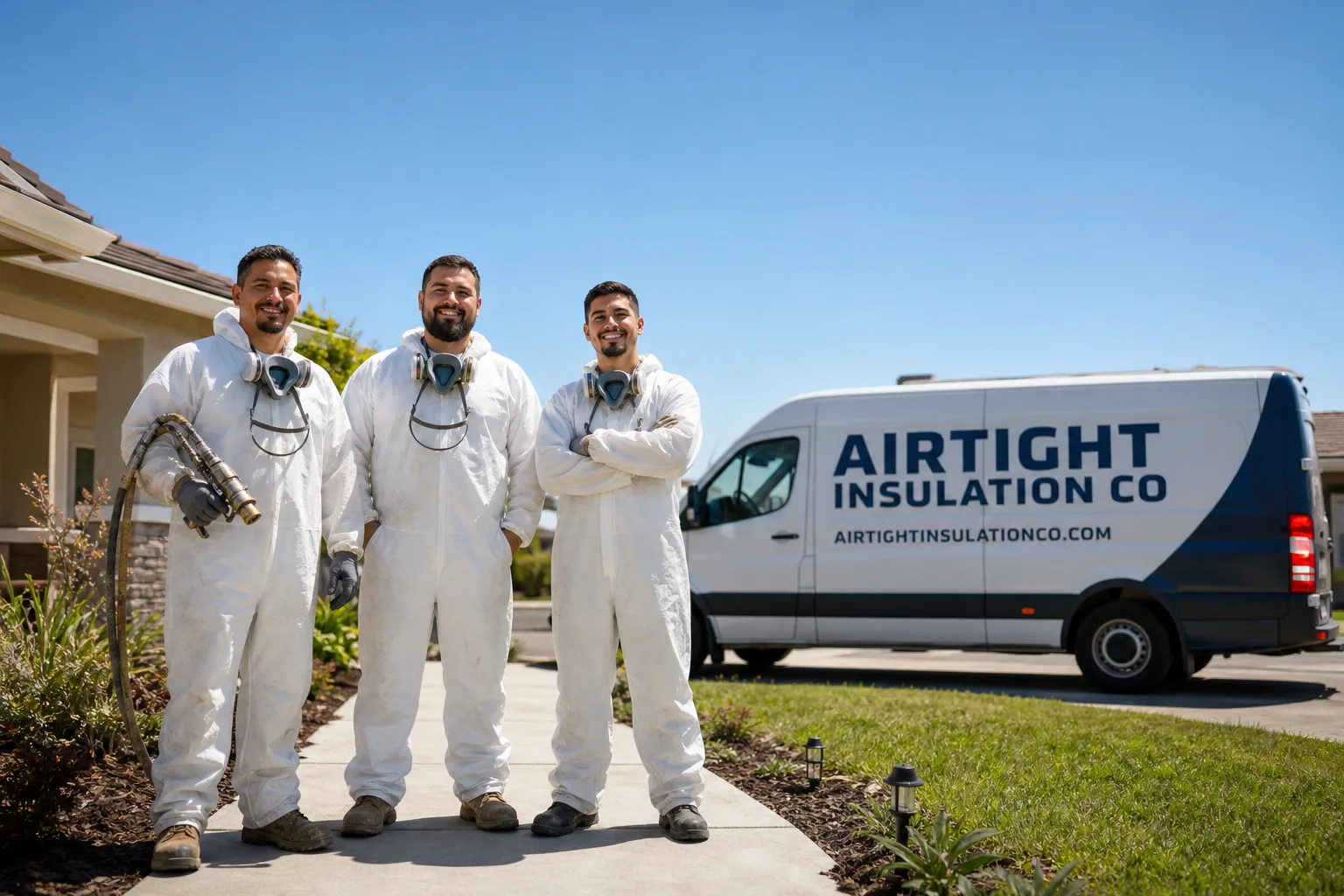
Fast, Reliable Spray Foam Insulation Across Shadow Hills
Spray foam insulation in Shadow Hills typically runs $2.75 – $5.50 per board foot installed, depending on whether you choose open-cell or closed-cell, and most residential jobs here wrap up in one to two days. If your energy bills spike every July and August while your AC struggles to hold 78 degrees, you’re feeling exactly what a poorly sealed attic in this corner of the San Fernando Valley does. We work in Shadow Hills weekly, know the canyon wind patterns off Hansen Dam, and understand that many of you are cooling ranch homes, workshops, and barns at the same time. Call Ruben Acosta and the Airtight Insulation Co crew at (833) 390-7079 for a straight answer and a free estimate.
Why Airtight Insulation Co Is Shadow Hills’s Preferred Spray Foam Insulation Company
Shadow Hills isn’t a tract-home suburb. It’s a semi-rural equestrian community inside Los Angeles where parcels are measured in acres, not square feet, and where a single property might have a 1960s ranch house, a detached four-car garage, a barn, and a tack room that all need different insulation treatments. We’ve foamed all of those structures, often on the same visit. That matters because most insulation contractors in the Valley are set up for one-house jobs. We run two-brand spray foam rigs, Icynene for open-cell interior applications and Demilec for closed-cell and rim joist work, plus mineral wool and blown-in fiberglass options when the job calls for something else. When a Shadow Hills customer calls, we don’t send a sales rep who measures and then schedules an install three weeks out. We send a crew that can often start the same week.
Ruben Acosta built Airtight Insulation Co around one principle: seal it, not just fill it. That principle means more in Shadow Hills than almost anywhere else in the Valley, because your heat loss is wind-driven. We’ve walked attics off Sunland Boulevard where forty years of canyon gusts through gable vents have compressed old fiberglass batts down to an inch of dead weight. We know what that looks like, and we know what fixes it.
Spray Foam Attic Insulation in Shadow Hills
Spray Foam Attic Insulation in Shadow Hills usually starts with air-sealing the top plates, can lights, and any chase where framing meets drywall, then applying foam to the deck or the floor of the attic depending on whether the space is vented. In Shadow Hills, the decision to foam an attic is rarely about cold winters. It’s about a 105-degree July afternoon, an attic that hits 140 degrees, and an AC unit that can’t keep up with conductive heat pouring through the ceiling.
Most Shadow Hills attics we see have some form of old blown-in fiberglass that’s been displaced by wind intrusion. That fiberglass acts as a filter, not an air barrier. Foam is the air barrier. The difference shows up in the first full billing cycle after the job.
Closed-Cell on the Roof Deck
For attics with HVAC equipment and ductwork up top, we often recommend closed-cell foam applied directly to the underside of the roof deck. This turns the attic into conditioned space, keeps your ducts from baking in 130-degree air, and seals the gable and eave penetrations in one pass. Demilec closed-cell product is our standard for this application. In Shadow Hills, where wildfire-zone construction expectations are increasingly standard on hillside lots, closed-cell foam also gives the assembly a tighter air seal than any fiberglass or cellulose method can deliver.
Radiant Barrier with Foam Sealing
Some Shadow Hills homeowners want the air-sealing benefit without the cost of a full deck foam job. That’s a legitimate middle path: open-cell foam at the top plates and penetrations, plus a radiant barrier across the underside of the rafters. The radiant barrier reflects heat, the foam kills the air movement. Combined, they typically cut attic heat transfer by 30 to 40 percent compared to fiberglass alone. We’ve done this combination on multiple properties near La Tuna Canyon Road and the results hold through August.
Spray Foam Wall Insulation in Shadow Hills
Spray Foam Wall Insulation in Shadow Hills makes the most sense during a remodel, a re-pipe, or any time the drywall is already off. On older mid-century ranch homes, we often find hollow wall cavities with nothing but tar paper and a prayer. Open-cell Icynene foam fills the cavity completely, seals every electrical box penetration, and does what no batt can do: it stops the air from moving through the wall assembly, not just the heat.
For new custom construction in Shadow Hills, where homeowners build once and plan to stay, closed-cell foam inside 2×6 walls delivers both air sealing and added structural rigidity. That’s a real benefit on hillside lots where wind loads on the west side of the property are meaningful. The per-square-foot cost is higher than fiberglass, but the difference in a Shadow Hills canyon home, with wind-driven infiltration, is measurable in the first season.
Rim Joist and Band Board Sealing
The rim joist is the most commonly missed air leak in any two-story or raised-foundation Shadow Hills home. We spray closed-cell foam into rim joist cavities, typically 2 to 3 inches, to stop the stack effect that pulls hot attic air down through wall cavities and cool conditioned air out through the band board. On crawl space homes, this single step usually makes the biggest comfort difference for the smallest material spend.
Garage Ceiling and Workshop Walls
Detached garages and shops in Shadow Hills are not afterthoughts. They’re frequently workspaces, storage for horse gear, or future ADUs. We foam garage ceilings on the regular, especially when there’s a bonus room above, and we’ve done full wall cavity foam on detached workshops where the owner wanted the space comfortable enough to work in through a Valley summer. These are exactly the multi-structure jobs that make Shadow Hills different from Burbank or La Crescenta. The scope isn’t one house. It’s the parcel.
Trusted Brands We Service in Shadow Hills
We don’t push one product. We let the job pick the product. For foam work in Shadow Hills, that usually means Icynene open-cell for interior walls and sound control, or Demilec closed-cell for attics, rim joists, and anything that needs a vapor and air barrier in one pass. For the fiberglass and radiant barrier side, we stock Owens Corning product locally in our Las Flores warehouse and can have full material loads on your Shadow Hills driveway the same day we quote. We also carry GreenFiber blown-in cellulose for homeowners who want a recycled-content option in a retrofit. Eight brands, one contractor. The point is that we stock what your house actually needs, not what’s easiest for a crew to spray.
We also keep enough Demilec and Icynene on hand to start a Shadow Hills job within the same week. No waiting on a regional distributor. No rescheduling because the rig ran dry.
Common Spray Foam Insulation Problems We See in Shadow Hills Homes
- Wind-displaced fiberglass under fresh foam. On mid-century Shadow Hills attics, decades of canyon wind through gable and eave vents have compressed the original blown-in fiberglass into uneven, useless layers. Spraying foam over that mess, without removing or accounting for the dead insulation first, traps moisture and wastes your money. We pull the old material, inspect the deck, then foam the right surface.
- Foam sprayed into gable and eave vents. In wildfire-zone hillside lots, sealing every vent with foam creates a fire-path vulnerability and ignores current ember-resistant venting guidance. The vents need to stay functional, ideally with ember-resistant covers, and the foam goes on the air barrier, not over the vent openings.
- Outbuilding jobs done without air-sealing first. A barn or tack room in Shadow Hills leaks air through oversized sliding doors, unsealed top plates, and framing gaps. Foaming the walls without sealing those openings first is like fixing one hole in a colander. We seal the framing, then apply foam to the wall or ceiling cavity.
- Moisture trapped against the deck. Closed-cell foam applied too thick, too fast, over a damp or compromised attic deck can lock moisture in. In Shadow Hills, where winter nights drop into the 40s and summer attic temps spike past 130, that temperature swing makes any trapped moisture a mold risk. The fix is knowing how many inches of foam a deck actually needs for this climate, not just spraying a default six.
Pricing for Spray Foam Insulation in Shadow Hills, CA
Open-cell spray foam in Shadow Hills runs $0.45 to $0.85 per board foot for material plus labor, while closed-cell runs $1.15 to $1.75 per board foot, with most finished jobs landing around $2.75 to $5.50 per board foot installed depending on depth and location. A typical 1,500-square-foot attic deck done with 5 inches of open-cell foam lands between $4,500 and $7,800. A rim joist and band board job on a 2,000-square-foot home usually runs $1,800 to $3,200. Detached workshop or barn walls add square footage and cost, but doing them on the same visit as the main house avoids a second mobilization charge. We give you a fixed quote before work starts, not a range with surprise adders. Call (833) 390-7079 for a free estimate at your Shadow Hills property and we’ll walk the structures with you.
We Also Serve Cities Near Shadow Hills
We work across the northeast Valley and the surrounding foothills. Beyond Spray Foam Insulation in Shadow Hills, our crews are regularly in Sunland, Tujunga, La Crescenta-Montrose, and Burbank. If you’re on a hillside lot off Sunland Boulevard or in a mid-century ranch near Whiting Woods, we know the terrain and the houses. And we’ve been serving this whole corridor long enough to know that Spray Foam Insulation in Shadow Hills means something different than it does in a Burbank stucco tract. It’s a different kind of property, and it gets a different kind of scope.
Serving Shadow Hills, CA — Our Local Coverage Area
We’re based in the Shadow Hills area and know this community well. Use the map below to see our service coverage — if you’re nearby, we can almost certainly help.
FAQs About Spray Foam Insulation in Shadow Hills
Yes, and in Shadow Hills it’s often the most valuable foam job on the parcel. A barn or tack room with unsealed framing and oversized door gaps leaks air faster than any house, and canyon wind makes it worse. Foaming the walls or ceiling of an outbuilding, after sealing the framing, turns it into a space that holds temperature. We routinely include one or two outbuildings on a Shadow Hills estimate because the rig setup cost is already covered.
Yes, but it’s a component, not the whole answer. Closed-cell foam as an air-sealing layer under a fire-rated ridge or soffit assembly, paired with ember-resistant venting, can strengthen the thermal and air barrier continuity of a hillside home. The critical mistake is foaming over gable and eave vents, which removes the venting function entirely. We spec foam in Shadow Hills with the wildfire-zone assembly in mind, not just the R-value chart.
Because canyon wind through gable and eave vents has usually displaced or compressed whatever insulation is already up there. Sealing the top plates, can light penetrations, and wire chases first means the foam goes onto a surface that can actually hold the air barrier. Skipping that step, in this climate, means you’re paying for foam that can’t do its job. Call (833) 390-7079 and we’ll show you what’s happening in your attic before recommending anything.
Not if it’s applied correctly. The failures we see come from closed-cell foam sprayed too thick over a damp or compromised deck, or over wind-displaced fiberglass that someone didn’t remove. Done right, with the correct depth for the Valley’s temperature swing and proper attention to the existing insulation, foam reduces the moisture risk because it eliminates the air movement that carries humid night air into the attic space. We’ve done enough Shadow Hills attics to know the difference between a proper deck seal and a future mold problem.
It handles it better than any batt or blown-in product. A Shadow Hills attic can hit 130 to 140 degrees in August, and closed-cell foam on the roof deck keeps that heat out of the living space and out of your ductwork. Open-cell foam on the attic floor seals the air barrier and stops the heat that radiates through the ceiling. Either way, your AC runs less and your rooms hold temperature longer through the hottest part of the day. Most Shadow Hills customers notice the difference in the first full month of a cooling season.
Ruben Acosta and the Airtight Insulation Co team are ready to look at your Shadow Hills property, including the outbuildings most contractors skip. Call (833) 390-7079 for a free estimate, or we can walk the parcel with you and give you a straight answer on what needs sealing and what doesn’t.
Written by Ruben Acosta, Owner at Airtight Insulation Co, serving Shadow Hills and the northeast San Fernando Valley.