
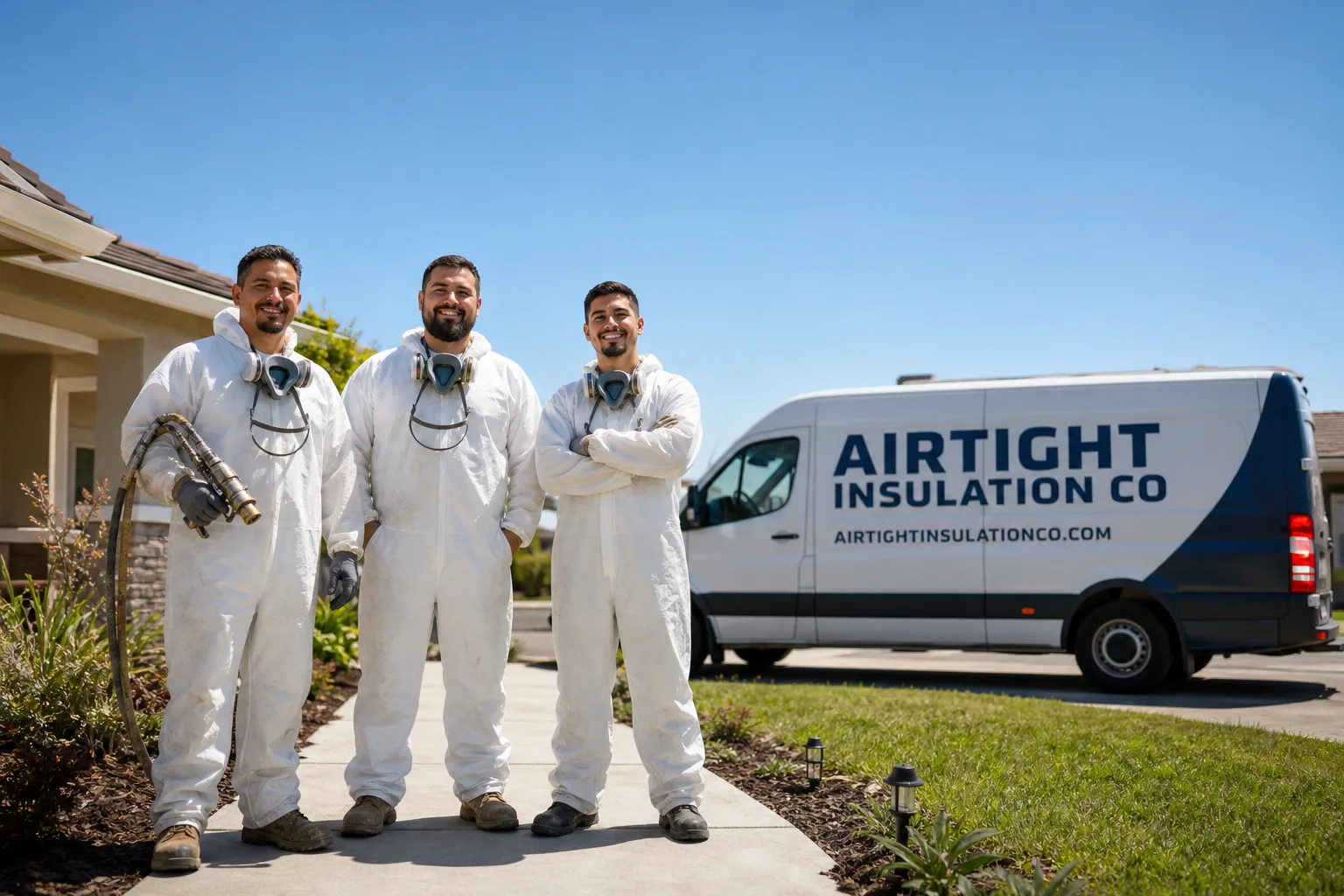
Fast, Reliable Spray Foam Insulation Across Santa Monica
Spray foam insulation in Santa Monica typically costs $2.50 – $6.50 per board foot installed, with most whole-wall or ceiling projects landing between $3,800 and $9,500 depending on cavity depth and foam type. Our crews are in Santa Monica weekly, and we can usually schedule an estimate within 48 hours and start work within 7 – 10 days. We know the single-wall bungalows south of Montana, the 1950s apartment buildings off Pico, and the newer infill north of Montana. Call (833) 390-7079 and we’ll give you a straight answer on what your structure actually needs.
Why Airtight Insulation Co Is Santa Monica’s Preferred Spray Foam Insulation Company
Ruben Acosta started Airtight Insulation Co because he kept seeing the same failure: insulation installed to hit an R-value, with air still moving through the wall. In Santa Monica, that’s a bigger problem than most cities because the marine layer doesn’t fight you with heat. It fights you with moisture. We’ve worked on 1920s redwood-siding bungalows near Franklin Street, 1950s wood-frame apartments in the Pico neighborhood, and newer builds in Ocean Park, and the diagnosis is rarely the same from one house to the next.
Our Spray Foam Insulation team carries both open-cell and closed-cell foam through Icynene and Demilec, which matters more in Santa Monica than people expect. Open-cell handles air sealing at a lower cost; closed-cell adds structural strength and a vapor barrier where moisture is a real threat. We let the job pick the product, not the other way around.
Santa Monica customers keep us accountable. When you’re insulating a rent-controlled duplex built in 1941 off 20th Street, the tenant notices if the bedroom still smells musty in June. That’s why we lead with air sealing, not just R-value. Seal it, not just fill it. It’s the standard we hold to because it’s the only one that works here.
Call us at (833) 390-7079 and we’ll schedule a walkthrough. We’ll measure wall depth, check for existing vapor barriers, and tell you honestly whether spray foam is the right call or whether blown-in or mineral wool makes more sense for your situation.
Garage Spray Foam Insulation in Santa Monica
Garage Spray Foam Insulation in Santa Monica is one of the most common jobs we book, and it’s usually for one of two reasons: a garage converted into a workshop or ADU, or a garage ceiling under a bedroom that never stops being cold. In Santa Monica’s older housing stock, garages are frequently detached, single-wall, and uninsulated, which means they swing with the fog. In the ZIP codes we serve most, 90401, 90402, 90404, and 90405, a standard two-car garage ceiling runs $1,900 – $3,800 for closed-cell foam applied directly to the underside of the roof deck, and walls run $2,800 – $5,500 depending on cavity access.
Thermal Barrier Requirements
Spray foam in a garage is not a simple spray-and-go job, especially in Santa Monica. Building code requires a thermal barrier, typically 1/2-inch drywall or an approved intumescent coating, between the foam and the living space. If your garage has exposed foam and you’re planning a future remodel or an ADU conversion, getting this right the first time saves you a costly tear-out later. We’ve seen Santa Monica inspectors flag this on final walkthroughs more than any other single item.
Moisture in Detached Garages
Santa Monica’s morning fog sits heavy on detached garages, and closed-cell foam on the roof deck does double duty here: it insulates and blocks moisture drive from the outside. If you use the garage as a wood shop or home gym, open-cell foam on the walls will quiet it down and stop the damp chill, but you’ll want closed-cell at the roofline where condensation forms.
Closed Cell Spray Foam Insulation in Santa Monica
Closed Cell Spray Foam Insulation in Santa Monica is the material we recommend when moisture and structural strength matter more than upfront cost. At roughly $3.00 – $6.50 per board foot, it’s more expensive than open-cell, but it gives you about R-6.5 per inch and acts as a vapor barrier. That matters in a city where the marine layer presses humidity against the walls for a large part of the year, and it’s especially important in the 1950s – 70s apartment buildings and older duplexes that make up so much of Santa Monica’s rental stock.
When the Building Needs Closed-Cell
Any time you’re insulating a wall that faces prevailing ocean moisture, or a rim joist where warm interior air meets cold framing, closed-cell is the safer choice. It bonds to the substrate, fills the cavity completely, and doesn’t sag over time. In the single-wall bungalows south of Montana Avenue, closed-cell is not typically injected into walls, because the cavities are too shallow. But it is used on the underside of roof decks and on the exterior as part of a rigid board assembly.
Demilec and Icynene in Santa Monica
We apply Demilec closed-cell foam on most Santa Monica jobs because of its consistent cell structure and proven longevity in coastal climates. Icynene’s open-cell product handles the air-sealing side of the equation at a lower cost. Having both brands in our inventory means we’re not nudging your project toward whatever foam happens to be on the truck.
Trusted Brands We Service in Santa Monica
We install and service two dedicated spray foam brands, Icynene and Demilec, and we back that with fiberglass and mineral wool options from Owens Corning and Rockwool when a hybrid approach makes more sense. Eight brands, one contractor. That’s not a marketing line. It’s a practical advantage when a 1940s Santa Monica bungalow needs closed-cell at the roofline, mineral wool in a fire-rated wall, and blown-in cellulose over a flat ceiling. We don’t have to call another sub. We handle it in one sequencing plan. For Santa Monica customers, that means faster installs, fewer scheduling conflicts, and one point of accountability from the first estimate through final cleanup.
Common Spray Foam Insulation Problems We See in Santa Monica Homes
- Closed-cell foam cracking redwood siding. South of Montana Avenue, older single-wall bungalows have original redwood siding that isn’t flexible. When closed-cell foam expands in a shallow cavity, it can exert enough pressure to split the boards. We see this most often when a previous contractor treated the house like a standard wood-frame build. These homes need shallow injection or an exterior rigid board approach, not full-cavity fills.
- Condensation trapped behind walls in 1950s – 70s apartments. Buildings from this era along Pico and in the mid-city corridor often have minimal or no cavity insulation and no vapor barrier. If open-cell foam is installed without an exterior vapor management strategy, ocean moisture can condense behind the assembly, leading to mold inside walls. The fix is closed-cell or a vapor-permeable assembly, not more R-value.
- Missing thermal barrier in garage ceiling foam applications. We regularly walk into Santa Monica garages where someone sprayed the ceiling and left the foam exposed. It’s a fire-code violation, and it’s a straight-up hazard. Marine humidity accelerates the surface degradation of exposed foam, and Santa Monica inspectors will require the barrier before you can finalize a sale or remodel.
- Improper rim joist sealing in raised foundations. Santa Monica’s older homes sit on raised wood foundations. The rim joist is the most common air leak point, and if it’s not sealed with closed-cell foam, the whole insulation job underperforms. Drafts at the floor, cold spots at exterior walls, and elevated heating bills in winter are the telltale signs.
Pricing for Spray Foam Insulation in Santa Monica, CA
Here’s what Santa Monica homeowners can expect to pay in 2025. Open-cell spray foam runs $2.50 – $4.50 per board foot; closed-cell runs $3.00 – $6.50. A garage ceiling in Santa Monica typically lands between $1,900 and $3,800. A full exterior wall insulation job on a 1,200-square-foot bungalow south of Montana runs $6,000 – $11,000 depending on whether we’re working from the interior or exterior. Rim joist sealing for a raised foundation runs $1,500 – $3,200. What moves the number: cavity access, whether we need scaffolding or a lift, whether the existing insulation has to be removed, and whether the job requires a thermal barrier for code. Estimates are free, and you’ll get a line-item number, not a hand-wave. Call (833) 390-7079 to schedule a walkthrough.
We Also Serve Cities Near Santa Monica
Our crew covers the full westside. We run Spray Foam Insulation in Santa Monica jobs every week, but we’re also out in Venice, Century City, Culver City, and Beverly Hills on a regular schedule. If you’re in one of those neighborhoods and looking for the same level of diagnostic detail, same number to call: (833) 390-7079.
Serving Santa Monica, CA — Our Local Coverage Area
We’re based in the Santa Monica area and know this community well. Use the map below to see our service coverage — if you’re nearby, we can almost certainly help.
FAQs About Spray Foam Insulation in Santa Monica
Spray foam can’t be injected into the walls of a true single-wall bungalow the way it can in a standard wood-frame home, because there’s no cavity to fill. The right approach is usually exterior rigid board with closed-cell foam at the roofline, or a shallow injection method with careful pressure control. We identify these homes by the lack of wall depth at electrical boxes and the presence of original redwood siding. Call (833) 390-7079 and we’ll take a look and tell you exactly what your walls can handle.
The marine layer drives moisture against your exterior walls for hours every morning, which means vapor management matters more than R-value here. Closed-cell foam acts as a vapor barrier and is the stronger choice for rim joists, roof decks, and any wall assembly where trapping moisture could cause mold. Open-cell is better for interior air sealing where the assembly can dry to the inside. The right answer depends on your wall structure and exposure, not on a generic chart.
Yes, but the application has to be chosen carefully. Rent-controlled buildings from the 1950s – 70s often have minimal cavity insulation and no vapor barrier. If the wrong foam goes in, condensation can collect behind the walls and create mold problems that become a habitability issue. We typically recommend closed-cell for exterior-facing walls in these buildings and open-cell for interior sound control. Call us at (833) 390-7079 for an assessment specific to your building.
Closed-cell foam is denser, costs more, adds structural strength, and acts as a vapor barrier. Open-cell is lighter, cheaper, and better for air sealing where moisture isn’t the primary threat. In Santa Monica’s coastal climate, closed-cell gets the nod for rim joists, garage ceilings, and any wall with ocean-facing exposure, while open-cell works well for interior partitions and soundproofing.
Yes. Garage ceiling and wall spray foam are some of our most requested services in Santa Monica, particularly for detached garages in the 90401 and 90405 ZIP codes. The work typically includes a thermal barrier to meet fire code, and we inspect for existing moisture issues before spraying anything. Most garage jobs take one to two days. Call (833) 390-7079 for a free estimate and we’ll get you scheduled.
If you’re dealing with a drafty bungalow near Franklin Street, a musty apartment off Pico, or a garage that won’t hold heat in June, we’ll give you a straight answer on what’s needed and what it’ll cost. Call (833) 390-7079 for a free estimate, or to talk through what you’re seeing in your Santa Monica home. We answer the phone.
Written by Ruben Acosta, Owner at Airtight Insulation Co, serving Santa Monica and the westside with spray foam, attic, and blown-in insulation.