
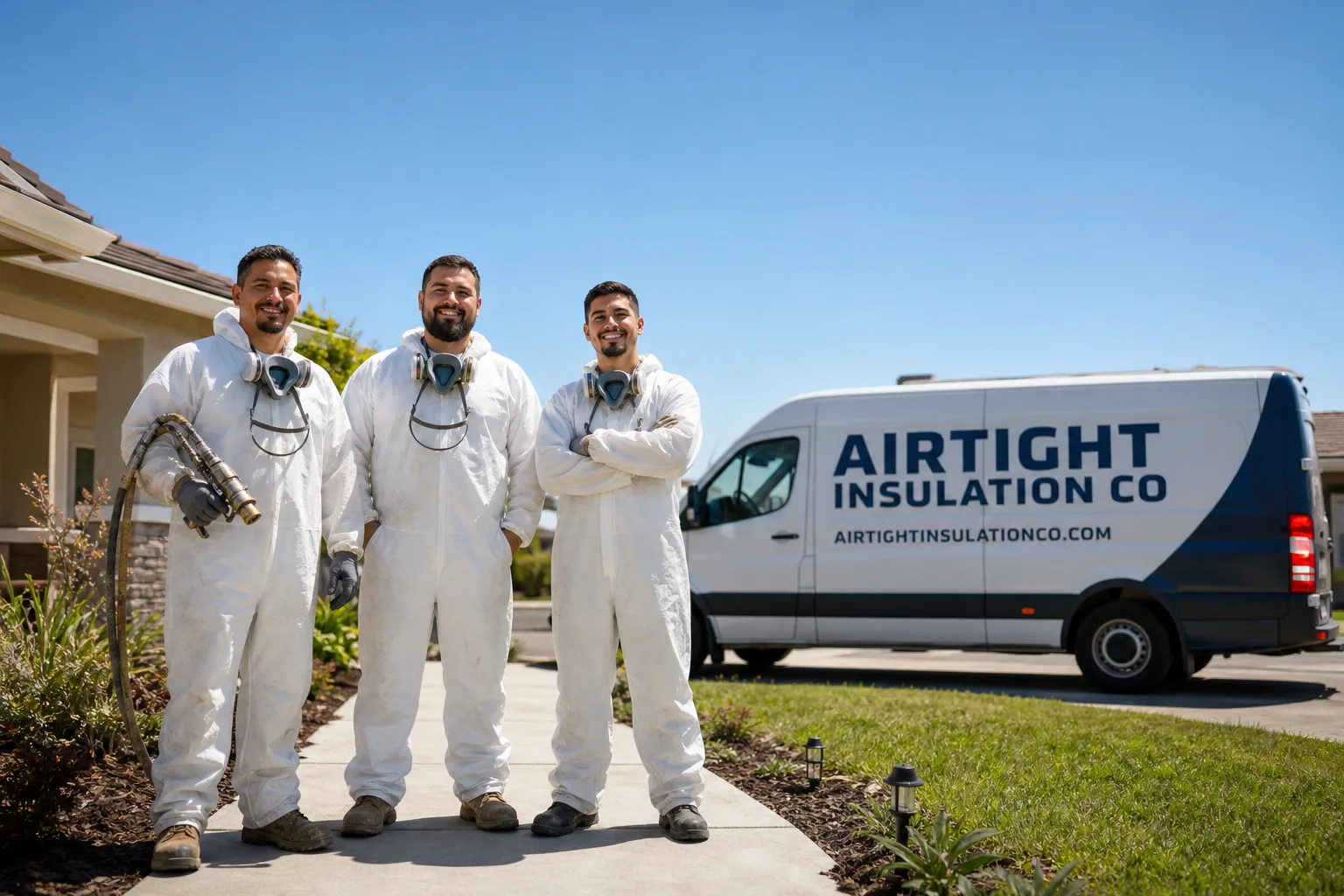
Fast, Reliable Spray Foam Insulation Across San Fernando
Spray foam insulation in San Fernando typically costs between $1.50 and $4.50 per board foot installed, depending on whether the job calls for open-cell or closed-cell chemistry. Most attic retrofit projects in the 91340 and 91341 zip codes run $2,800 to $7,200 for a standard single-family home. Our crews reach San Fernando daily from our Las Flores base, usually within a day or two of your call. If your attic is baking at 140°F and your AC can’t keep up, call (833) 390-7079 for a free estimate and we’ll tell you straight what your house actually needs.
San Fernando isn’t like the coastal parts of LA County. Summer heat out here is relentless, and the housing stock is older than most people realize. That combination means spray foam decisions that work fine in Santa Monica fail badly here. We’ve spent years working in the northeast Valley, and we know what these attics do to insulation. Ruben Acosta started Airtight Insulation Co to fix exactly this kind of problem: homes where the original insulation gave up decades ago and nobody caught it.
Why Airtight Insulation Co Is San Fernando’s Preferred Spray Foam Insulation Company
We’re not the cheapest spray foam contractor in San Fernando, and we’re fine with that. We’re the one that carries eight manufacturer brands, including Icynene and Demilec, and picks the material based on what your specific attic actually needs. Most insulation companies push whatever they have in the warehouse. We let the job pick the product. That’s why homeowners on streets near San Fernando High School, around the historic downtown core, and out toward the 210 freeway call us when a previous insulation job underdelivered.
Our San Fernando customers tend to come from referrals. A homeowner off Maclay Avenue gets their attic foamed, feels the difference by the next heat wave, and sends their neighbor our way. The work we do here is specific: heat-stabilized closed-cell foam for roof decks that hit 140°F, open-cell for ceiling planes where air sealing matters more than raw R-value, and careful detailing around old wiring that inspectors in this city check for. You can’t fake that kind of local knowledge with a generic install crew.
Key Takeaways
- Closed-cell spray foam in San Fernando runs $2,800 – $7,200 for a typical attic retrofit
- Open-cell runs $2,200 – $5,400 for similar square footage
- We spec heat-stabilized closed-cell for roof decks in 91340 and 91341 attics that routinely hit 140 – 150°F
- Same-week service to San Fernando from our Las Flores location
- Free estimates: (833) 390-7079
Ruben Acosta will walk your attic personally on most San Fernando estimates. That’s not a sales pitch. It’s just how we work. The person quoting the job should be the person who understands what the foam has to do in this specific climate.
Closed Cell Spray Foam Insulation in San Fernando
Closed Cell Spray Foam Insulation in San Fernando is the spec we recommend for roof deck undersides and rim joists in older homes across the 91340 zip, because its dense closed-cell structure holds up under sustained attic heat that would degrade lesser foams. This is the material that turns a 140°F attic from a liability into a conditioned buffer zone. Closed-cell acts as an air barrier, a vapor barrier, and a structural reinforcement all at once. In San Fernando’s pre-1970s housing stock, where original attic insulation is often compressed to an inch or less, closed-cell on the underside of the roof sheathing creates a conditioned attic that actually protects your ductwork from the Valley sun.
Closed-cell projects in San Fernando typically run $3,500 to $7,200 for an average attic, depending on square footage and access. The product itself usually costs more than open-cell because it delivers roughly double the R-value per inch (around R-6.5 to R-7 per inch) and adds shear strength to the roof assembly. For homes with AC units and ducts up in the attic, which is most of San Fernando’s older single-family housing stock, that’s the difference between an AC unit fighting 150°F air and one fighting 100°F air.
Because San Fernando sits in the hot, smoggy northeast Valley where summer attic temperatures routinely hit 140 – 150°F, closed-cell spray foam applied to the underside of roof decks must be rated for sustained high-heat exposure. Standard open-cell foams can off-gas and degrade in these attics. We spec heat-stabilized closed-cell, including Demilec Heatlok, for roof-line applications here. Not every foam on the market can handle a San Fernando August. This is the number one failure we see from contractors who don’t know the Valley.
Heat-Stabilized Roof Deck Applications
When we spray the roof deck in a San Fernando home, we’re not just adding R-value. We’re changing the thermal boundary of the entire house. A properly foamed roof deck in 91340 brings attic temperatures down by 30°F or more on a hot afternoon. That means your AC ductwork, which probably runs through that attic, stops losing a third of its cooling capacity to the attic air. The foam chemistry matters: Demilec’s high-heat formulations are the only ones we’ll put directly on a roof deck that sees the kind of sun load San Fernando gets from June through October.
Rim Joist and Band Board Sealing
Homes in San Fernando built before 1980 almost never have sealed rim joists. That’s the band around the top of the foundation, and in the older tracts near the eastern flats it’s a gap-fest. Closed-cell foam seals those gaps and stops the stack effect that pulls hot attic air down through wall cavities. It’s a smaller job, usually $1,200 to $2,800, but it’s often the single biggest air-sealing win in an older San Fernando house.
Open Cell Spray Foam in San Fernando
Open Cell Spray Foam in San Fernando is the smart choice for attic ceiling planes in homes where the roof deck stays vented and the goal is air sealing plus insulation at a lower cost per board foot. It’s lighter, expands more aggressively into cracks and odd cavities, and does an excellent job of locking out the smog and dust that blows across the northeast Valley. Open-cell delivers around R-3.7 per inch, so we spec it thicker, usually 10 to 11 inches for an R-38 ceiling plane cap in San Fernando.
Open-cell jobs in San Fernando typically run $2,200 to $5,400, which makes it the more budget-conscious option for a ceiling-plane retrofit. The trade-off is clear: open-cell is not a vapor barrier, and it’s not rated for direct roof deck application in the extreme heat San Fernando attics see. We use it where it belongs: on the attic floor or ceiling plane, over existing drywall, sealing the top plates and the hundreds of small penetrations older homes accumulate over decades.
There are real failure modes with open-cell in this city, and we tell homeowners about them before we sell anything. Open-cell foam applied directly to the underside of roof sheathing in 140 – 150°F attics off-gasses and loses structural integrity within a few summers. This is a Valley-specific heat failure that doesn’t show up in coastal neighborhoods or cooler inland zones. Some contractors do it anyway because it’s cheaper and faster. We won’t.
Ceiling Plane Air Sealing
The highest-impact open-cell application in San Fernando is the ceiling plane. Older homes around the historic downtown core leak conditioned air through every top plate penetration, light fixture, and interior wall junction. We seal those with open-cell, then blow or spray the full ceiling plane to R-38. It seals out the smog and dust that pours in through attic bypasses. Homeowners near San Fernando Mission Boulevard tell us the indoor air quality change is noticeable within days.
Wall Cavity Injection for Thin-Wall Construction
Some of the original 1920s-40s bungalows near downtown San Fernando have wall cavities that are either empty or stuffed with degraded material. Open-cell foam injected into those cavities from the interior or exterior is a practical retrofit that doesn’t require gutting walls. The foam expands into the irregular old stud bays and locks them up. It’s not the cheapest job, but for a pre-war bungalow with no wall insulation, nothing else comes close.
Trusted Brands We Service in San Fernando
We stock and install both Icynene and Demilec spray foam products, which means we’re not tied to a single manufacturer’s spec sheet. For San Fernando’s heat-specific needs, Demilec’s high-temperature closed-cell formulations are our go-to roof deck solution. Icynene’s open-cell products handle ceiling planes and wall cavities well. We also carry Owens Corning and GreenFiber for fiberglass and blown-in applications, so if the right answer for your house turns out to be something other than spray foam, we’ll tell you that instead of forcing a foam sale. Supporting eight brands means the material recommendation follows the job conditions in your San Fernando home, not the other way around.
On a 1948 bungalow near the historic downtown core in 91340, our crew found the original attic insulation compressed to less than an inch and a scorched radiant barrier peeling off the rafters. That’s a direct result of 140°F+ summer attic heat baking the roof assembly for decades. We removed the failed barrier, air-sealed the top plates and knob-and-tube penetrations with closed-cell foam, then sprayed open-cell over the ceiling plane for an R-38 cap. The homeowner’s late-afternoon attic temperature dropped roughly 30°F. That job is the kind of work we do again and again in San Fernando’s older housing stock.
Want a full breakdown of our Spray Foam Insulation capabilities? Our service hub page covers the options in detail. For anything specific to this city, keep reading.
Common Spray Foam Insulation Problems We See in San Fernando Homes
- Melted and delaminated radiant barriers under old insulation: The reflective surface fails under sustained 140°F attic heat, then foam sprayed over it cannot adhere properly. We see this constantly in the older tract homes along the eastern flats, and it has to be addressed before any new foam goes in.
- Open-cell foam on roof decks that wasn’t heat-rated: It off-gasses and loses structural integrity within a few summers. The homeowner is usually told they have insulation when they actually have a failing polymer layer.
- Foam sprayed directly over knob-and-tube wiring: The foam causes heat buildup in the concealed wiring. San Fernando inspectors flag this specifically in pre-1950s housing stock, and the fix involves isolating the wiring before any foam touches it.
- Compressed original insulation from decades of Valley heat: Fiberglass and cellulose compress dramatically under sustained heat exposure. In many 91340 homes, the original R-19 measures out to R-4 or less today. The homeowner thinks they have insulation. They don’t.
Pricing for Spray Foam Insulation in San Fernando, CA
Here’s what we’re seeing for actual San Fernando jobs in 2026. Closed-cell roof deck applications on an 1,100 to 1,800 square foot home in 91340 run $3,500 to $7,200. Open-cell ceiling plane work on the same footprint runs $2,200 to $5,400. Rim joist sealing is usually $1,200 to $2,800 depending on the foundation perimeter. Wall cavity injection on older bungalows can add $3,000 to $6,000 beyond the attic work. What moves the number: access (crawl spaces and low-slope roofs add labor hours), square footage of the thermal boundary, and whether we’re removing failed insulation or radiant barrier first. Call (833) 390-7079 and we’ll give you a straight number after walking the attic, not before.
We Also Serve Cities Near San Fernando
Our crews work throughout the northeast Valley from our Las Flores base. If you’re searching for Spray Foam Insulation in San Fernando and surrounding areas, we cover North Hills, Shadow Hills, Northridge, and Van Nuys with the same heat-specific detailing and the same brands. We’ll be straight with you about what your specific attic needs, wherever you are in the northeast Valley.
Serving San Fernando, CA — Our Local Coverage Area
We’re based in the San Fernando area and know this community well. Use the map below to see our service coverage — if you’re nearby, we can almost certainly help.
FAQs About Spray Foam Insulation in San Fernando
Both, but the mechanism matters. If we spray closed-cell on the underside of the roof deck, the attic itself becomes conditioned space and drops 25 – 35°F on a hot afternoon, which protects your ductwork and your AC’s efficiency. If we spray open-cell on the ceiling plane only, the rooms below stay cooler because conditioned air stops leaking into the attic, but the attic stays hot. For most San Fernando homes with ducts in the attic, the roof deck application is the higher-impact choice. Call (833) 390-7079 to walk through your specific setup.
No, not directly. Foam over knob-and-tube creates a heat trap around the conductors and San Fernando inspectors flag it every time on pre-1950s homes. The wiring has to be isolated first, usually by a licensed electrician running new circuits, or we work around the affected bays. We’ve done this on many of the older bungalows near the historic downtown core. We’ll tell you exactly what your house needs before any foam is sprayed.
We recommend R-38 minimum for the ceiling plane and R-21 to R-30 closed-cell equivalent on the roof deck for homes in San Fernando. The Valley’s sustained 140°F+ attic temperatures mean the standard R-30 recommendation used in cooler parts of LA County doesn’t hold up here. For roof deck work, we use heat-stabilized closed-cell because standard formulations degrade under repeated high-heat cycles. Estimates are free, and we’ll give you a spec based on your actual attic, not a generic chart.
Yes, and that’s one of the primary reasons San Fernando homeowners choose it over fiberglass batts. Open-cell and closed-cell both function as air barriers, blocking the particulate matter that enters through attic bypasses, wall penetrations, and rim joist gaps. The northeast Valley’s air quality is measurably worse than the coastal side, so sealing the building envelope has a bigger indoor-air-quality payoff here than in most LA neighborhoods.
Winter performance is secondary in San Fernando, where the heating season is short and mild. The real workload here is summer cooling, which is why we prioritize air sealing and high-heat-rated products over raw R-value alone. A sealed attic with R-38 open-cell on the ceiling plane will outperform a leaky attic with R-60 batts in San Fernando because the air sealing is what stops the heat gain. That’s the “seal it, not just fill it” principle in practice.
Ready to find out what your San Fernando attic actually needs? Call (833) 390-7079 and Ruben Acosta or one of our senior techs will walk it with you. The estimate is free, the answer will be honest, and if spray foam isn’t the right call for your house, we’ll tell you what is.
Written by Ruben Acosta, Owner at Airtight Insulation Co, serving San Fernando and the northeast San Fernando Valley.