
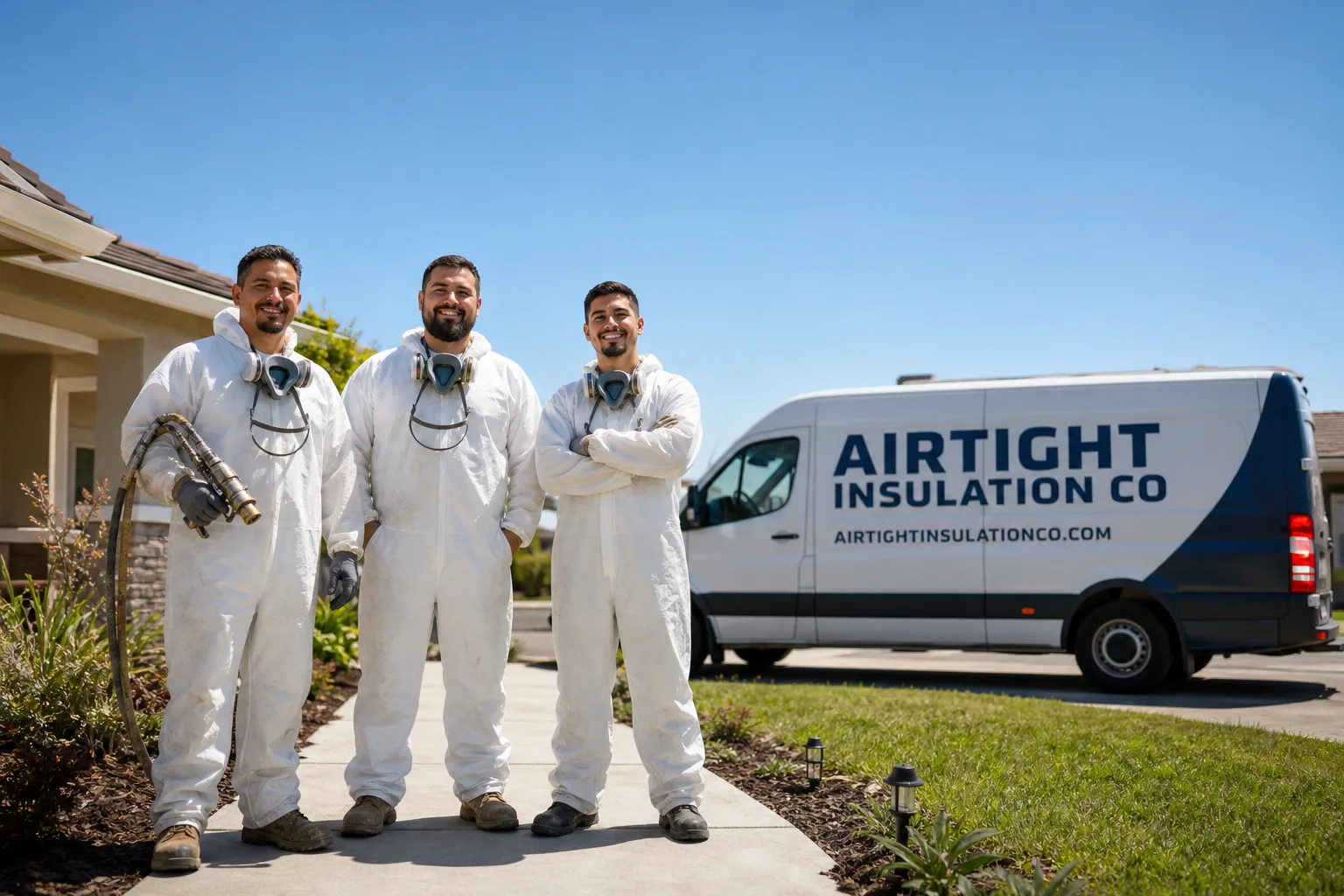
Fast, Reliable Attic Insulation Across Marina del Rey
Attic insulation in Marina del Rey is rarely about staying warm. Most of the calls we take from the 90292 and 90295 zip codes come from condo and townhome owners dealing with two things: sound bleeding through floor-ceiling assemblies, and marine-layer moisture wrecking whatever insulation was put in decades ago. If you’re in a stacked building off Admiralty Way or a townhome cluster near Via Marina, you already know the problem. You hear every footstep from upstairs. Your west-facing ceiling feels damp in June. Your energy bills don’t match the square footage.
Airtight Insulation Co handles these jobs differently than the insulation contractors who treat Marina del Rey like any inland suburb. We start by asking what you’re actually trying to fix: neighbor noise, humidity, heat gain through the roof deck, or all three. Then we let the building tell us which material fits. Call (833) 390-7079 and we’ll give you a straight answer, not a sales script.
Why Airtight Insulation Co Is Marina del Rey’s Preferred Attic Insulation Company
Ruben Acosta founded Airtight Insulation Co on a simple measuring stick: the work is right when air stops moving through the assembly, not when someone dumps in enough R-value to pass a checklist. That standard fits Marina del Rey better than most cities, because a building sitting on fill at the water’s edge has different problems than a track home in the valley. Moisture moves through stucco and sheathing. Sound travels through shared framing. An insulation crew that doesn’t understand marine-layer physics will install a product that looks fine for two years and fails quietly after that.
We’ve worked in enough Marina del Rey buildings to know what’s behind the walls before we open them: 1960s low-rise apartments with no vapor barrier worth mentioning, 1970s townhomes with deteriorated fiberglass batts compressed under roof decks, and 2000s condos where the builder’s insulation was spec’d for thermal code and never addressed acoustics at all. That local knowledge changes the recommendation. It’s why our Attic Insulation team carries eight manufacturer lines across fiberglass, mineral wool, spray foam, and cellulose, so the material gets matched to the actual condition, not to whatever’s left in the truck.
We respond to Marina del Rey service calls fast, because we know parking and access on narrow harbor streets adds 20 minutes to every trip. Our scheduling accounts for that. And our crews are used to working around HOA rules, shared wall constraints, and building managers who want to see proof of insurance before the ladder comes off the truck.
Attic Insulation Removal in Marina del Rey
Attic Insulation Removal in Marina del Rey usually starts with a problem you didn’t plan to solve: a musty smell drifting down from the ceiling, an inspection report flagging mold-prone pockets, or the discovery that your 1970s-era fiberglass has compressed to half its original thickness and stopped doing anything at all. Removing old insulation in a Marina del Rey building requires care, because you’re often working in a tight attic space above someone else’s unit, with limited access through a closet ceiling hatch. Our crews vacuum out the old material, inspect the deck and framing for moisture damage, and prep the assembly for whatever comes next. A typical removal job in Marina del Rey runs $1,200 to $2,800 depending on attic size, access, and whether we’re dealing with loose-fill, batts, or something worse.
When Removal Becomes Necessary
Marine-layer humidity is the usual culprit. West- and south-facing roof decks in Marina del Rey absorb moisture during fog-heavy months, and that moisture wicks into the insulation below. You won’t see it from inside the unit. You’ll smell it eventually, or a neighbor will. If the insulation is damp, compressed, or showing signs of rodent activity, adding new material on top just traps the problem.
Prep Before New Installation
After removal, we inspect baffles, check ventilation paths at the eaves, and verify the condition of any vapor-retarder layers. In many Marina del Rey condos, the original baffles are crushed or missing entirely, which is why the next insulation job fails early. Fixing that before new material goes in is the difference between a five-year fix and a twenty-year one.
Insulation Contractors in Marina del Rey
Insulation Contractors in Marina del Rey are not interchangeable, and the cheap bids usually show up without the right materials for waterfront construction. Airtight Insulation Co operates as a multi-solution insulation specialist, which means we’re not trying to sell you the one product we happen to stock. We carry Owens Corning and Johns Manville fiberglass, Rockwool mineral wool, Icynene and Demilec spray foam, and GreenFiber cellulose. The job picks the product. For a sound-isolation project between stacked units, that’s usually Rockwool Safe’n’Sound or Owens Corning acoustic bats. For an air-sealing job on an ocean-facing roof deck, it’s often Icynene open-cell foam before any batt goes in. For a budget-conscious thermal top-up, blown-in GreenFiber cellulose gets the job done at $1.50 to $2.75 per square foot installed, depending on depth.
Sound-Rated Assemblies for Condos
Most Marina del Rey insulation work we do isn’t thermal at all. It’s acoustic. When someone in a mid-rise condo calls us about attic insulation, nine times out of ten they’re trying to quiet upstairs footfall or reduce neighbor noise bleeding through a shared ceiling. That changes everything about the spec: material density matters more than thickness, and air gaps at the perimeter become the primary enemy. We detail the assembly to seal those gaps, not just fill the cavity.
The Appliance of Choice: Air Sealing First
Seal it, not just fill it. That’s the standard we work to on every Marina del Rey job, because a perfectly filled insulation cavity with unsealed air channels still leaks sound and moisture. Spray foam at the transitions, around duct penetrations, and along the top plates closes those channels before any batt or blown-in material goes down.
Trusted Brands We Service in Marina del Rey
We install and warranty attic insulation from eight manufacturers, but on Marina del Rey jobs we lean toward a few for specific reasons. Rockwool mineral wool handles moisture without losing its shape or R-value, and it adds meaningful sound isolation on top of that. Owens Corning acoustic fiberglass gives us a lighter, more affordable option for standard condo ceiling assemblies. Knauf batts fill in where a standard thermal job makes sense. We stock materials locally for Marina del Rey customers, so a top-up or targeted sound-isolation project doesn’t wait on a distributor’s delivery schedule. Eight brands, one contractor; the recommendation always comes from the building condition, not inventory convenience.
Common Attic Insulation Problems We See in Marina del Rey Homes
- Marine-layer moisture compressing insulation on west-facing roof decks. Fog and onshore humidity push moisture into the deck sheathing, where it wicks into the insulation below and flattens it. You lose thermal performance, but worse, you create mold-prone pockets that often go undetected until a neighbor or HOA inspector raises the issue.
- Blown-in insulation settling unevenly in tight alley-load attics. When the attic access is a small hatch in a closet ceiling, installers can’t always reach the far corners properly. The material settles, gaps open above party walls, and the sound isolation everyone assumed was there never actually existed.
- Stucco-over-frame walls trapping humidity between insulation and sheathing. In many 1960s and 1970s Marina del Rey buildings, the original wall assembly had no vapor management to speak of. Insulation added later makes it worse, locking moisture against the framing on ocean-facing elevations and degrading both thermal and acoustic performance.
- Footfall noise transferring through floor-ceiling assemblies. Stacked condos share structural framing, so impact noise from upstairs travels down the joists and through the ceiling. Batts alone don’t stop it. You need density, air sealing at the perimeter, and sometimes a resilient channel or decoupling detail to break the vibration path.
Pricing for Attic Insulation in Marina del Rey, CA
Here are real numbers for the Marina del Rey market, based on the jobs we bid and complete here. Blown-in cellulose insulation runs $1.50 to $2.75 per square foot installed, with most attic top-ups landing between $900 and $2,200 for a typical condo or townhome. Sound-rated Rockwool batts run $2.25 to $3.50 per square foot, and that’s the product most of the acoustic work in this area actually needs. Full removal plus re-insulation of a standard two-bedroom townhome attic in Marina del Rey typically lands between $2,800 and $5,400, depending on access, condition of the existing assembly, and whether we’re adding air-sealing details. Spray foam runs more, $4.00 to $6.50 per square foot, but it solves moisture and air-sealing problems that batts alone can’t. Call (833) 390-7079 and we’ll give you an exact number for your building, not a range pulled from a national average.
We Also Serve Cities Near Marina del Rey
Airtight Insulation Co handles attic insulation across the South Bay and coastal corridor. If you’re in Marina del Rey or nearby in Lawndale, Hermosa Beach, Redondo Beach, or Hawthorne, the same crew and the same eight-brand approach applies. Call us at (833) 390-7079 and we’ll tell you what your building actually needs, wherever you’re located.
Serving Marina del Rey, CA — Our Local Coverage Area
We’re based in the Marina del Rey area and know this community well. Use the map below to see our service coverage — if you’re nearby, we can almost certainly help.
FAQs About Attic Insulation in Marina del Rey
Yes, and this is the most common reason people call us from Marina del Rey condos and townhomes. The key is using dense, sound-rated material like Rockwool Safe’n’Sound or Owens Corning acoustic batts, and sealing every air gap at the assembly perimeter. Loose-fill fiberglass will not do it. Impact noise travels through framing, so the insulation needs density and the installation needs air sealing at every transition. If you hear every footstep from upstairs, call (833) 390-7079 and ask for a sound-isolation assessment.
The marine layer pushes humid air into west- and south-facing roof decks and walls for months at a time, and that moisture ends up in the insulation. Fiberglass loses R-value when damp, cellulose settles, and both create conditions where mold can grow quietly. The fix is a combination of vapor management, proper ventilation, and material that doesn’t break down when exposed to humidity. In practice, that often means Rockwool on the ocean-facing side of the assembly. Get a proper diagnosis before adding material; adding over damp insulation just seals the problem in.
Parking is usually the first constraint, especially off Via Marina or Admiralty Way during peak hours. Our trucks carry compact equipment and our crews know the loading-zone rules. The second issue is the attic hatch itself, which in most Marina del Rey townhomes is a small opening in a closet ceiling or hallway. That limits how far blown-in material can be distributed evenly, so we often recommend batts for tight-access attics to guarantee consistent coverage. We’ll tell you before we start what the access looks like and how it affects the install.
In most Marina del Rey buildings, yes. Old fiberglass batts from the 1960s through the 1990s are usually compressed, damp, or harboring dust and debris that will compromise the performance of any new material installed on top of them. If the existing insulation is dry, intact, and the right product for the job, we can top up over it. But for sound-isolation work specifically, starting with a clean, inspected assembly gives you the best result. The cost of removal is usually small compared to the cost of doing the job twice.
Rockwool Safe’n’Sound and Owens Corning acoustic fiberglass are our go-to products for sound-focused work in Marina del Rey. Rockwool carries higher density and better moisture resistance, which matters in marine-layer conditions. Owens Corning gives us a lighter option at a lower price point where the assembly doesn’t need the extra density. If air sealing is also part of the scope, we’ll pair either product with Icynene spray foam at the perimeter transitions. The right choice depends on your specific assembly, not a brand preference.
If you’re in Marina del Rey and the attic insulation question is actually a noise problem, a moisture problem, or both, call Airtight Insulation Co at (833) 390-7079 for a free estimate. We’ll send someone who knows these buildings, works around the parking and access constraints, and tells you the truth about what your attic actually needs.
Written by Ruben Acosta, Owner at Airtight Insulation Co, serving Marina del Rey and the South Bay with application-driven insulation solutions.